ConGen Africa

GENETIC MANAGEMENT GUIDELINES

Sable Antelope Hippotragus niger

A single species of sable antelope Hippotragus niger (Harris 1938) is currently recognised across wooded savanna in southern and East Africa. The species occurs from the south of Kenya to South Africa, with a separated population in Angola. Other species within the Hippotragus genus include the extinct bluebuck (H. leucophaeus) and roan antelope (H. equinus). For permitting purposes in southern Africa, Namibia and South Africa currently utilise Hippotragus niger niger (the southern or common sable). There are currently four recognised subspecies and one newly suggested subspecies in western Tanzania (Rocha et al. 2022). This assessment adopted morphological and genetic evidence of four/five subspecies, providing the basis for the recognition of five Evolutionarily Significant Units (ESUs) across the continent and three Genetic Management Units (GMUs) in southern Africa. Figure 1 illustrates the geographic distribution of these ESUs and GMUs and also indicates localities where natural contact zones appear to exist between them. The validity of the fifth subspecies/ESU requires priority research.


Figure 1: Natural distribution of sable antelope (Hippotragus niger) ESUs, indicated by different colours. Genetic Management Units (GMUs) are indicated by different symbols, with the colour corresponding to the ESU to which it belongs. Each point represents a locality which has been sampled for genetic data and thus the GMU (symbol) and ESU (colour) designation of each locality is based on genetic data. The inset indicates the part of Africa shown in the main map. Distribution data sources: South Africa – Birss, C., Rushworth, I., Collins, N. B., Peinke, D. & Buijs, D. 2017. Inferred natural distribution ranges of certain large mammals in South Africa. Unpublished GIS coverage. Rest of Africa – IUCN (International Union for Conservation of Nature) 2008. Hippotragus niger. The IUCN Red List of Threatened Species. Version 2021-1. https://www.iucnredlist.org. 

Management Level

Subspecies

Four subspecies of sable antelope are recognised based on morphological characteristics (Nowak 1999; Groves 1983) and genetic data (Pitra et al. 2006; Jansen van Vuuren et al. 2010).

  • Hippotragus niger roosevelti (eastern sable antelope)
  • Hippotragus niger kirkii (Zambian sable antelope)
  • Hippotragus niger variani (giant sable antelope)
  • Hippotragus niger niger (common or southern sable antelope)


However, the guidelines provided in this document are based on genetic data translated into the Evolutionarily Significant Units (ESUs) and Genetic Management Units (GMUs) listed below.

Evolutionarily Significant Units (ESUs)
  • Eastern (EE) corresponds to eastern sable antelope (H. n. roosevelti)
  • West Tanzanian (WT) which corresponds to suggested new subspecies; Rocha et al. 2022 
  • Zambian (ZM) which corresponds to Zambian sable antelope (H. n. kirkii)
  • Angolan (AO) or giant sable antelope (H. n. variani)
  • Southern (SO) corresponds to common or southern sable antelope (H. n. niger)
Genetic Management Units (GMUs)
  • Eastern (EE)
    • West-Eastern (WE)
    • Mid-Eastern (ME)
    • North-Eastern (NE)
  • Southern (SO)
    • West-Southern (WS)
    • Mid-Southern (MS)
    • East-Southern (ES)

Management boundaries

See Figure 1 for visual representation and figure legend for more detail.

Evolutionarily Significant Units (ESUs)
  • West Tanzanian (WT) (suggested new subspecies): western Tanzania.
  • Eastern (EE): (H. n. roosevelti): Kenya, north-east Tanzania, south-east Tanzania, eastern Zambia, Malawi, northern Mozambique.
  • Zambian (ZM) (H. n. kirkii): Zambia (excl. east) & Democratic Republic of Congo.
  • Angolan (AO) (H. n. variani): Angola.
  • Southern (SO): (H. n. niger): south of Zambezi River – Namibia, Botswana, Zimbabwe, south-central Mozambique, South Africa.
Genetic Management Units (GMUs)
  • Southern (SO)
    • West-Southern (WS): north-east Namibia, south-east Angola, south-west Zambia and north-west Botswana.
    • Mid-Southern (MS): South Africa, Botswana, Zimbabwe, southern Mozambique.
    • East-Southern (ES): eastern south-central Mozambique.

Genetic Risk

  • Global Nc: 50,000-60,000 (IUCN 2017).
  • South African Nc: 664 – 775 (Muller et al. 2025).
  • Genetic indicators are calculated at ESU level as there is insufficient data to calculate for GMUs. These calculations are based on a best case scenario where gene flow is maintained.
    • Risk levels for GMUs can be assumed based on the Ne500 at ESU level.
  • If values are reported as a range, the average is used for subsequent calculations.

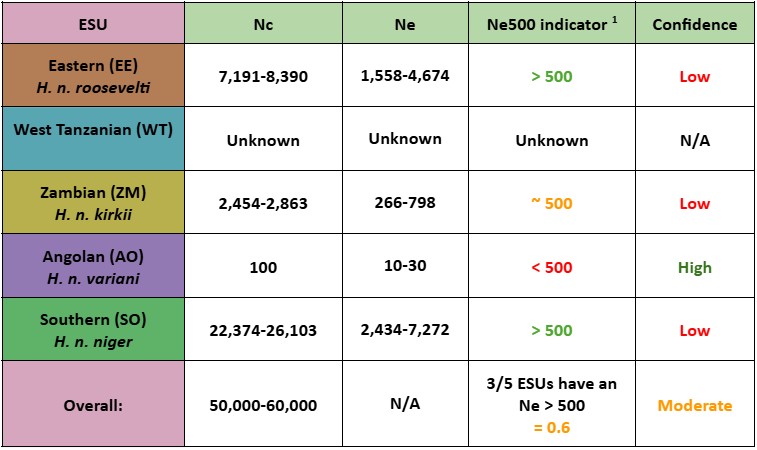
Table 1. Effective population size, Ne500 indicator, and confidence in the values calculated per ESU for sable antelope. Colour of the ESU label is linked to the colour used in Figure 1. Colour of Ne500 and confidence text corresponds to positive (green) or negative  interpretation (orange/red). Overall Ne500 indicates the proportion of the total ESUs that have an Ne over 500.
Genetic Indicators
  • Ne500 indicator1
    • Eastern (EE) individuals: > 11,985 (East 1999). With assumed maturity percentage of 60-70 % (Parrini et al. 2016), Nc: 7,191-8,390. Using an Nc:Ne ratio of 0.1-0.3, Ne = 1,558-4,674.
    • West Tanzanian (WT) Nc: Unknown.
    • Zambian (ZM) individuals: 4,090 (East 1999). With assumed maturity percentage of 60-70 % (Parrini et al. 2016), Nc: 2,454-2,863. Using an Nc:Ne ratio of 0.1-0.3, Ne = 266-798.
    • Angolan (AO) Nc: 100 (IUCN 2017). Using an Nc:Ne ratio of 0.1-0.3, Ne = 10-30.
    • Southern (SO) individuals: 37,290 (East 1999). With assumed maturity percentage of 60-70 % (Parrini et al. 2016), Nc: 22,374-26,103. Using an Nc:Ne ratio of 0.1-0.3, Ne = 2,434-7,272.

      Based on Ne500, the Zambian and Angolan ESUs are most at risk genetically, with the Angolan ESU Ne well under 500 and the Zambian ESU having an Ne only just above 500 on average. ESUs with Ne < 500 are highly susceptible to rapid loss of genetic diversity and are at high risk of extinction due to genetic threats. Figure 2 summarises findings.

 
  • Proportion of populations maintained (PM2):
    • The global populations of sable antelope make up four subspecies, with a fifth subspecies being proposed by Rocha et al. (2022),  relating to the five ESUs. Therefore the proportion of populations maintained globally: 5/5 = 1.
  •  
Diversity Loss
  • Functional variation: There is risk of functional variation loss due to massive reduction in historical range causing fragmented/isolated populations. Due to this, there has likely been a loss of traits that were adapted to habitats the species formerly occupied. 
  • Divergent lineages: There is risk of losing divergent lineages as the subspecies, the giant sable (Angolan ESU) is critically endangered (Vaz Pinto et al. 2016).
  •  
Hybridisation/introgression
  • There is strong evidence of hybridisation and introgression within giant sable populations in Angola with roan antelope (Vaz Pinto et al. 2016). Additionally, outdated existing genetic tests may lead to unintended mixing and hybridisation of ESUs.
Lower turnover/constraints on adaptive opportunities
  • There has been a noted decrease in sable antelope population densities since the 1970s until the 2010s where these appeared to stabilise (Parrini et al. 2016). This may still have an impact on population turnover, constraining adaptive opportunities.
  •  
In situ genetic threat level
  • In situ risk (Moderate)
    Sable antelope exist in small, fragmented populations and can hybridise with roan antelope (Hippotragus equinus). Hybridisation presents genetic risks in reduction of functional variation. This issue is especially problematic in Angola for the giant sable subspecies (Vaz Pinto et al. 2016). For more threats, see the IUCN Red List and South African Red List.
 
  • Confidence in in situ threat level
    • Confidence score (Moderate)
      Confidence is moderate as the evaluation is based on scientific papers (Vaz Pinto et al. 2019) and IUCN or regional assessment data from within the last decade (IUCN 2017; Muller et al. 2025; Parrini et al. 2016). However, population numbers per ESU to calculate Ne500 were assumed from data provided in East (1999) and the population is assumed to have remained stable (IUCN 2017). This confidence score is based on several assumptions and could potentially misrepresent interpretation and also current population census sizes.
  •  
Ex situ representation
  • Sable exist in captive populations within southern Africa and North America.
  • North American individuals are in private ranches and zoos, similar to wildlife reserves where they are seen in southern African countries.
  • Captive individuals are predominantly from Zambian sable or southern sable; hybridisation between these two ESUs in captive populations is widespread (Koepfli et al. 2019).
Figure 2. Effective population size compared to confidence in the value. Colour of points and labelling corresponds to the ESU in Figure 1 and Table 1. Dashed lines divide the x axis into above and below Ne500, and the y axis into low and high confidence. ESUs in the low confidence quadrant should be further surveyed to increase confidence in the evaluation. Those with high confidence below Ne500 should have increased genetic management. Note that the WT ESU is not shown due to data deficiency.

1 Proportion of populations within species with an effective population size (Ne) greater than 500

(https://www.gbf-indicators.org/metadata/headline/A-4)


2 Proportion of populations maintained within species

(https://ccgenetics.github.io/guidelines-genetic-diversity-indicators/docs/2_Theoretical_background/PM-indicator.html)

Management Guidelines

  • No import of sable from countries containing the other ESUs.
  • No translocation between GMUs (based on microsatellite data) within the Southern ESU, however, natural migration should be promoted (Vaz Pinto 2018). 
  • Efforts must be made to increase the effective population size of the Angolan and Zambian ESUs to over 500.  
  • Natural gene flow between populations within ESUs should be promoted to increase effective population size (increase Ne >500).
  • Captive bred animals and those on private ranches must be genetically tested before translocation to ensure no admixture between ESUs.
  • There has been historical isolation of maternal lineages within the Zambian and Southern ESUs north and south of the Zambezi River (Rocha et al. 2022). As a precautionary principle, these mitochondrial DNA lineages should not be mixed through anthropogenic translocations.

IUCN Status:

  • Global: Least concern (indicated below).
  • South Africa: Vulnerable. 

Limitations & Assumptions

  • Private ranches in South Africa, Namibia, Zimbabwe, Botswana and south-central Mozambique (the natural range of the Southern ESU) may have some individuals from the Zambian ESU and/or the Eastern ESU and/or West Tanzanian ESU.

Priority Research

  • Existing genetic tests based on mitochondrial DNA must be updated to reflect the latest and most robust (at this point) knowledge from Rocha et al. (2022).
  • More samples from the Southern ESU should be genetically analysed, particularly from South Africa, to determine if they qualify as an additional GMU. 
  • A South African-wide genetic assessment of sable antelope to determine the prevalence of hybrid individuals between ESUs.
  • ESUs with low Ne500 confidence should be surveyed to enable an up to date evaluation of their genetic risk, especially the West Tanzanian ESU which has no population data.
  • It is recommended that genetic monitoring studies be undertaken every 3-5 generations, if possible, to evaluate whether any changes in the genetic structure and diversity of this species have taken place, possibly warranting an update to these guidelines. Such studies would also contribute to the assessment of genetic indicators  under the Kunming-Montreal Global Biodiversity Framework. Note: such studies would not be to assess local pedigree, but rather broad population structure and diversity, and hence the overall genetic health of the species.

Cited References

  • Groves, C.P. (1983). A new subspecies of sable antelope, Hippotragus niger (Harris 1838). Revue Zoologique Africaine 97, 821-828.
  • IUCN SSC Antelope Specialist Group. 2017. Hippotragus niger. The IUCN Red List of Threatened Species 2017: e.T10170A50188654. https://dx.doi.org/10.2305/IUCN.UK.2017-2.RLTS.
  • Jansen van Vuuren, B. et al. (2010). Western Zambian sable: are they a geographic extension of the giant sable antelope? South African Journal of Wildlife Research 40, 35-42. doi.org/10.3957/056.040.0114.
  • Muller, K.L., Russo, I.M., da Silva, J.M., Kruger, J., and Selier, S.A.J. 2025. A conservation assessment of Hippotragus niger. In Patel, T., Smith, C., Roxburgh, L., da Silva, J.M. and Raimondo, D., editors. The Red List of Mammals of South Africa, Eswatini and Lesotho. South African National Biodiversity Institute and Endangered Wildlife Trust, South Africa.
  • Nowak, R.M. (1999). Walker’s Mammals of the World. 6th ed. The Johns Hopkins Press, Baltimore.
  • Parrini F, Koen J, Dalton D, Eksteen J. 2016. A conservation assessment of Hippotragus niger niger. In Child MF, Roxburgh L, Do Linh San E, Raimondo D, Davies-Mostert HT, editors. The Red List of Mammals of South Africa, Swaziland and Lesotho. South African National Biodiversity Institute and Endangered Wildlife Trust, South Africa.
  • Pitra, C. et al. (2006). DNA-led rediscovery of the giant sable antelope in Angola. European Journal of Wildlife Research 52, 145–152. doi.org/10.1007/s10344-005-0026-y.
  • Rocha, J.L. et al. (2022). African climate and geomorphology drive evolution and ghost introgression in sable antelope. Molecular Ecology 31, 2968-2984. doi.org/10.1111/mec.16427.
  • Vaz Pinto, P. (2018). Evolutionary history of the critically endangered giant sable antelope (Hippotragus niger variani) – insights into its phylogeography, population genetics and conservation. PhD Thesis. University of Porto.


Additional References

Consultation

  • IUCN SSC Conservation Genetics Specialist Group
  • IUCN SSC Antelope Specialist Group

Acknowledgements

We are grateful to Prof Francesca Parrinia and Dr Pedro Vaz Pinto for their valuable comments and for taking the necessary time and effort to critically review the initial guidelines.

Queries

If you have any additional questions related to these guidelines, please contact ConGen Africa at info@congenafrica.com.

Explore other species