ConGen Africa

GENETIC MANAGEMENT GUIDELINES

Blue wildebeest Connochaetes taurinus

Ansell (1972) listed the following five subspecies of blue wildebeest: brindled wildebeest (C. t. taurinus Burchell, 1823), Cookson’s wildebeest (C. t. cooksoni Blaine, 1914); Nyassa wildebeest (C. t. johnstoni Sclater, 1896); eastern white-bearded wildebeest (C. t. albojubatus Thomas, 1892); and western white-bearded wildebeest (C. t. mearnsi Heller, 1913). The brindled wildebeest is widely distributed in southern Africa (Angola, Zambia, Namibia, Mozambique and South Africa), whereas the Cookson’s wildebeest has a restricted distribution in Zambia in the Luangwa Game Reserve. The Nyassa wildebeest went extinct from Nyasaland by the end of the 19th century, however, this subspecies still occurs north of the Zambezi River in Mozambique and into east-central Tanzania. The Gregory Rift Valley in Kenya and Tanzania divides the eastern-and-western white-bearded wildebeest distribution areas. These subspecies are used for permitting purposes in southern Africa. Genetics research (Arctander et al. 1999), including recent genome-level analyses (Liu et al. 2024), supports the five subspecies that are herein treated as Evolutionarily Significant Units (ESUs, Figure 1). There are at least two Genetic Management Units (GMUs, Figure 1), within the brindled ESU that is separated by the Zambezi river. 
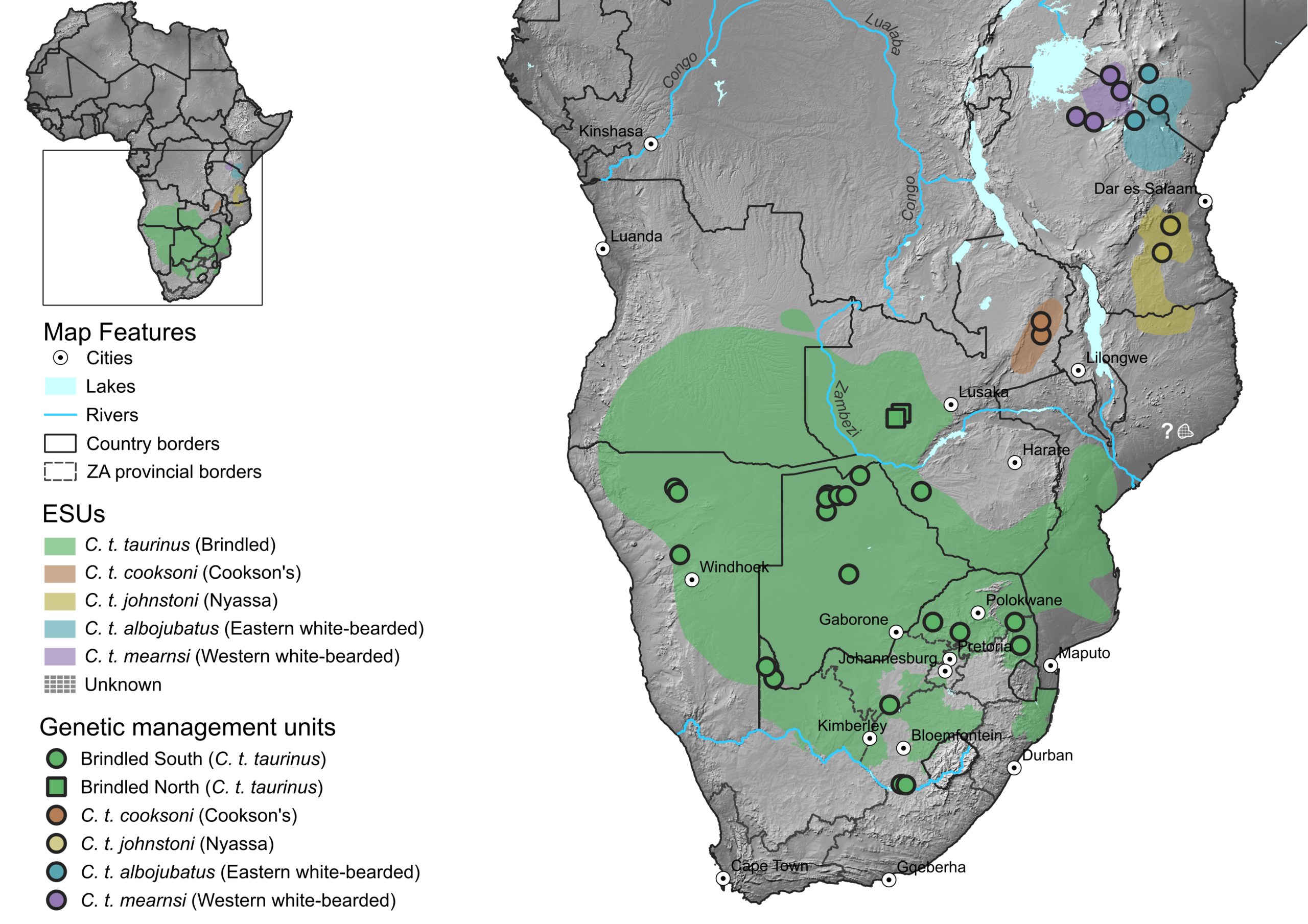
Figure 1:  Natural distribution of blue wildebeest (Connochaetes taurinus) subspecies shown in different colours. Points represent a locality which has been sampled for genetic data. The inset indicates the part of Africa shown in the main map. Distribution data sources: South Africa, Lesotho and eSwatini – Birss, C., Rushworth, I., Collins, N. B., Peinke, D. & Buijs, D. 2017. Inferred natural distribution ranges of certain large mammals in South Africa. Unpublished GIS coverage. Rest of Africa – IUCN (International Union for Conservation of Nature) 2016. Connochaetes taurinus. The IUCN Red List of Threatened Species. Version 2021-1. https://www.iucnredlist.org

Management Level

Subspecies

Five subspecies of blue wildebeest are recognised, based on genetic and morphological data.

  • Connochaetes taurinus mearnsi (western white-bearded wildebeest)
  • Connochaetes taurinus albojubatus (eastern white-bearded wildebeest)
  • Connochaetes taurinus cooksoni (Cookson’s wildebeest)
  • Connochaetes taurinus johnstoni (Nyassa or Johnston’s wildebeest)
  • Connochaetes taurinus taurinus (brindled gnu/wildebeest)

The guidelines provided in this document are based on genetic data, which confirms that the subspecies are equivalent to Evolutionarily Significant Units (ESUs).

Evolutionarily Significant Units (ESUs)

See under Subspecies heading above.

Genetic Management Units (GMUs)
  • Connochaetes taurinus mearnsi
    • No GMUs
  • Connochaetes taurinus albojubatus
    • No GMUs
  • Connochaetes taurinus cooksoni
    • No GMUs
  • Connochaetes taurinus johnstoni 
    • No GMUs
  • Connochaetes taurinus taurinus
    • Brindled North: Brindled population in Kafue and potentially other populations north of the Zambezi river.
    • Brindled South: Blindled populations south of the Zambezi river. However, additional sampling may reveal further genetic structure within this GMU. See priority research.

Management boundaries

See Figure 1 for visual representation and figure legend for more detail.
Subspecies
  • Connochaetes taurinus mearnsi: Serengeti-Mara ecosystem of northern Tanzania and southern Kenya west of the Gregory Rift Valley.
  • Connochaetes taurinus albojubatus: northern Tanzania to central Kenya south of the Equator and west to the Gregory Rift Valley. 
  • Connochaetes taurinus cooksoni: restricted distribution in Zambia in the Luangwa Game Reserve.
  • Connochaetes taurinus johnstoni: north of the Zambezi River in Mozambique and into east-central Tanzania.
  • Connochaetes taurinus taurinus: Angola, Zambia, Namibia, Mozambique and South Africa.

Genetic Risk

  • Global Nc: 1,085,000 (IUCN 2016; Patel and da Silva 2025).
  • South African Nc: 13,000 (Patel and da Silva 2025). 
  • Genetic indicators are calculated at ESU level. These calculations are based on a best case scenario where gene flow is maintained.
    • Risk levels for GMUs can be assumed based on the Ne500 at ESU level.
  • If values are reported as a range, the average is used for subsequent calculations.
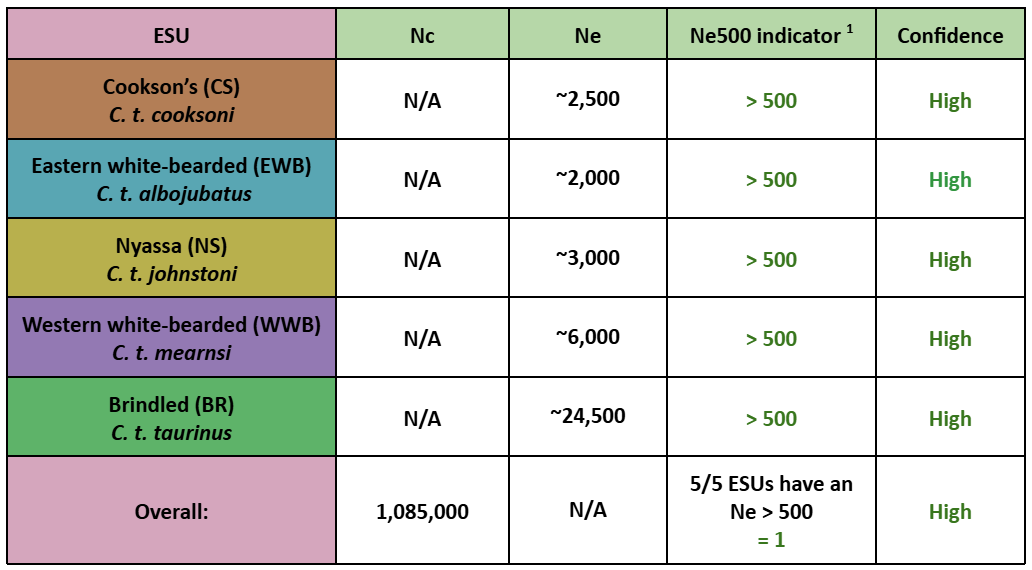
Table 1. Effective population size, Ne500 indicator, and confidence in the values calculated per ESU for blue wildebeest. Colour of the ESU label is linked to the colour used in Figure 1. Colour of Ne500 and confidence text corresponds to positive (green) or negative  interpretation (orange/red). Overall Ne500 indicates the proportion of the total ESUs that have an Ne over 500.
Genetic Indicators
  • Ne500 indicator1
  • Cookson’s (CS) Ne was based on genetic data from Lui et al. 2024. For comparative context, individuals: 5,000-10,000 (Estes and East 2009). With assumed maturity percentage of 70 % (Patel and da Silva 2025), Nc: 5,250.
  • Eastern white-bearded (EWB) Ne was based on genetic data from Lui et al. 2024. For comparative context, individuals: 6,000-8,000 (Estes and East 2009). With assumed maturity percentage of 70 % (Patel and da Silva 2025), Nc: 4,900. 
  • Nyassa (NS) Ne was based on genetic data from Lui et al. 2024. For comparative context, individuals: 50,000-75,000 (Estes and East 2009). With assumed maturity percentage of 70 % (Patel and da Silva 2025), Nc: 43,750. 
  • Western white-bearded (WWB) Ne was based on genetic data from Lui et al. 2024. For comparative context, individuals: 1,300,000 (Estes and East 2009). With assumed maturity percentage of 70 % (Patel and da Silva 2025), Nc: 910,000.
  • Brindled (BR) Ne was based on genetic data from Lui et al. 2024. For comparative context, individuals: 130,000 (Estes and East 2009). With assumed maturity percentage of 70 % (Patel and da Silva 2025), Nc: 91,000. 

All ESUs have an Ne above 500 which indicates each will maintain genetic diversity, assuming gene flow is maintained, thus indicating lower genetic risk.

  • Proportion of populations maintained (PM2):
    • The global populations of blue wildebeest make up five subspecies relating to the five ESUs. Therefore the proportion of populations maintained globally: 5/5 = 1.
Diversity Loss
  • Functional variation: There is risk of functional variation loss due to massive reduction in historical range. Due to this, there has likely been a loss of traits that were adapted to habitats the species formerly occupied. Several colour variants of blue wildebeest (e.g. golden and king) are routinely bred on private wildlife ranches in the region. Escapees from such ranches threaten the genetic integrity of natural populations. 
  • Divergent lineages: There is risk of losing divergent lineages if the EWB ESU continues to see decline at the same rate as has been occurring since the 90s. 
Hybridisation/introgression
  • There is risk of hybridisation for blue wildebeest with the closely related species, black wildebeest (Power 2014). Some game ranches still stock the two species together and introgression is seen within the blue wildebeest genome (Grobler et al. 2018). There are signals of historic hybridisation as well as current extant hybrids (Grobler et al. 2005; 2018).
  • Admixture between ESUs within the species has not been detected (Liu et al. 2024).
Lower turnover/constraints on adaptive opportunities
  • The population numbers of blue wildebeest have remained relatively stable since the 1990s, with only the EWB showing decline. Increased human disruption within migration routes have shown to decrease the population of blue wildebeest within those areas. This has particularly affected the EWB ESU which has seen significant decline since the 90s and shows signs of low genetic diversity (Caspers et al. 2020; East 1999; Liu et al. 2024).
In situ genetic threat level
  • In situ risk (Low)
    Blue wildebeest exist in relatively large populations, with the Serengeti having upwards of a million individuals. The species faces issues due to hybridisation with black wildebeest (Connochaetes gnou). Hybridisation presents genetic risks in reduction of functional variation. All ESUs have an Ne above 500, with EWB being the ESU most at risk due to past declines. For more threats, see the IUCN Red List and South African Red List.

  • Confidence in in situ threat level
    • Confidence score (High)

Confidence is high as the evaluation is based on scientific papers (Grobler et al. 2018; Liu et al. 2024) and IUCN or regional assessment data from within the last decade (IUCN 2016; Patel and da Silva 2025). Population numbers per ESU to calculate Ne500 were assumed from data provided in Estes and East (2009) and the population is assumed to have remained stable (IUCN 2016).
Ex situ representation
  • Blue wildebeest exist in captive populations within South Africa, Egypt, Asia, Europe, and North America, with a total of 935 individuals across 113 in 31 countries. North America has the largest ex situ stock, with 264 individuals.
  • North American captive individuals are predominantly from the EWB ESU; despite instances of introduction of other ESUs, there does not seem to be any introgression (Caspers et al. 2020).
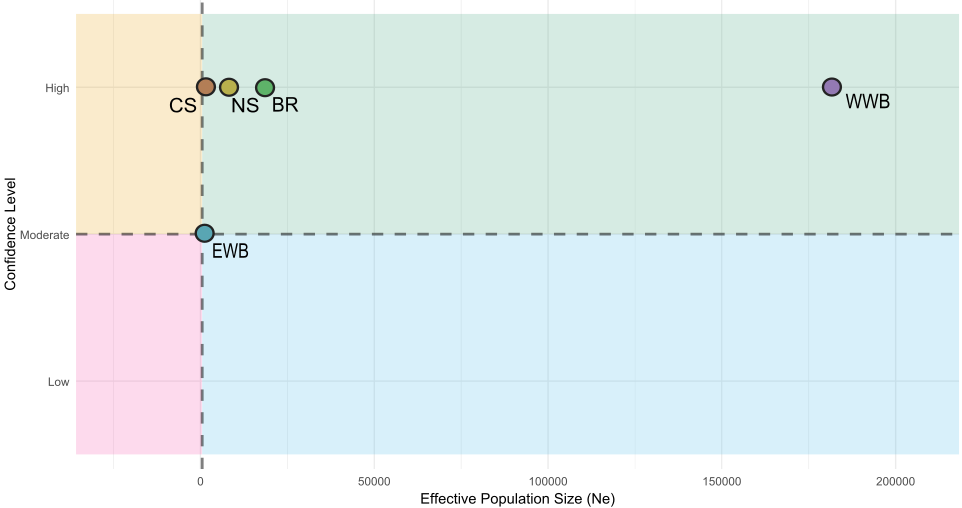
Figure 2. Effective population size compared to confidence in the value. Colour of points and labelling corresponds to the ESU in Figure 1 and Table 1. Dashed lines divide the x axis into above and below Ne500, and the y axis into low and high confidence. ESUs in the low confidence quadrant should be further surveyed to increase confidence in the evaluation. Those with high confidence below Ne500 should have increased genetic management.

1 Proportion of populations within species with an effective population size (Ne) greater than 500
(https://www.gbf-indicators.org/metadata/headline/A-4)

2 Proportion of populations maintained within species
(https://ccgenetics.github.io/guidelines-genetic-diversity-indicators/docs/2_Theoretical_background/PM-indicator.html)

Management Guidelines

  • Manage blue wildebeest as five separate subspecies with no imports of the other four subspecies into southern Africa.
  • Translocations must mimic a stepwise pattern between geographically close natural populations.
  • If both blue- and black wildebeest are (or were) kept on the same property, all animals should be genetically tested before translocation to ensure no hybrid individuals are moved.
  • All ESUs within the species have an Ne > 500 under the assumption of gene flow. Therefore, management must strive to facilitate natural migration and gene flow between isolated populations, while taking cognisance of the other guidelines above.

IUCN Status:

  • Global: Least concern (indicated below).
  • South Africa: Least concern. 

Limitations & Assumptions

  • Blue wildebeest (specifically the brindled wildebeest subspecies, C. t. taurinus) has been widely translocated within and outside of its natural distribution ranges in South Africa, without taking hybridisation with black wildebeest into account. Therefore, admixed/hybrid individuals may have been used as founders of new blue wildebeest populations and/or mixed with pure blue wildebeest populations. 

Priority Research

  • A comprehensive study on C. t. taurinus, including all areas in the natural distribution should be conducted to get a better picture of genetic differentiation and potential cryptic diversity (Grobler & Van der Bank, 1993; Liu et al. 2024). 
  • A more powerful panel of molecular markers is required to increase the confidence with which hybrids (especially 2nd or 3rd generation backcrosses) can be detected and to preserve the genetic integrity of the species (Grobler et al. 2018). 

Cited References

  • Ansell, W.F.H. (1972) Family Artiodactyla. In: J. Meester & H.W. Setzer (eds). The Mammals of Africa: An Identification Manual, Part 2 15, pp, 1-84, Smithsonian Institution Press, Washington D.C.
  • Arctander, P. et al. (1999). Phylogeography of three closely related African bovids (Tribe Alcelaphini). Molecular Biology and Evolution 16, 1724-1739. doi:10.1093/oxfordjournals.molbev.a026085.
  • Caspers LM, Ferrie GM, Wolfe K, Hoffman EA. Subspecific identity and a comparison of genetic diversity between wild and ex situ wildebeest. Zoo Biology. 2020; 39: 129–140. https://doi.org/10.1002/zoo.21530 
  • Grobler, P. et al. (2018). Assessing introgressive hybridization between blue wildebeest (Connochaetes taurinus) and black wildebeest (Connochaetes gnou) from South Africa. Conservation Genetics 19, 981-993. doi.org/10.1007/s10592-018-1071-x.
  • Grobler, J. P. et al. (2005). The genetic status of an isolated black wildebeest (Connochaetes gnou) population from the Abe Bailey Nature Reserve, South Africa: microsatellite data on a putative past hybridization with blue wildebeest (C. taurinus). Mammalian Biology 70, 35-45. doi.org/10.1078/1616-5047-00174.
  • Grobler, J. P., & Van der Bank, F. H. (1993). Genetic variability in South African blue wildebeest (Connochaetes gnou). Comparative Biochemistry and Physiology Part B: Comparative Biochemistry 106, 755-762. doi.org/10.1016/0305-0491(93)90159-3.
  • IUCN SSC Antelope Specialist Group. 2016. Connochaetes taurinus (errata version published in 2020). The IUCN Red List of Threatened Species 2016: e.T5229A163322525. https://dx.doi.org/10.2305/IUCN.UK.2016-2.RLTS.T5229A163322525.en
  • Patel, T. and da Silva, J.M. 2025. A conservation assessment of Connochaetes taurinus. In Patel T, Smith C, Roxburgh L, da Silva JM & Raimondo D, editors. The Red List of Mammals of South Africa, Eswatini and Lesotho. South African National Biodiversity Institute and Endangered Wildlife Trust, South Africa.
  • Liu, X. et al. (2024). Introgression and disruption of migration routes have shaped the genetic integrity of wildebeest populations. Nature Communications 15, 2921. doi.org/10.1038/s41467-024-47015-y.

Consultation

Acknowledgements

We are grateful to Profs Paul Grobler and Rouvay Roodt-Wilding and Dr David Mallon for their valuable comments and for taking the necessary time and effort to critically review the initial guidelines.

Queries

If you have any additional questions related to these guidelines, please contact ConGen Africa at info@congenafrica.com.

Explore other species