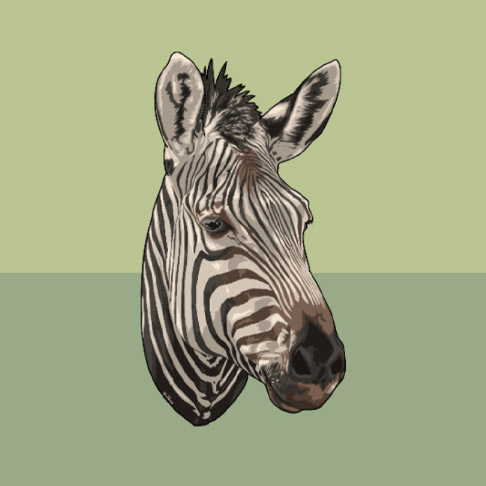
The black rhinoceros Diceros bicornis (Linnaeus 1758), belonging to the family Rhinocerotidae, is one of two extant species of African rhinoceros. It is a large herbivorous mammal endemic to Sub-Saharan Africa, with a broad historical range now significantly reduced. It is found along the east of Africa, from South-Sudan to the tip of South Africa, and west into Angola and Namibia. For permitting purposes in southern Africa, D. b. bicornis (the south-western black rhino) is recognised in Namibia, Angola, Botswana, and South Africa, and D. b. minor (the south-central black rhino) is recognised in South Africa, Zimbabwe, Eswatini, and Mozambique. There are four presumed subspecies of black rhino, with three currently considered extant (Balfour et al. 2025). This assessment adopted morphological and genetic evidence of four subspecies, providing basis to recognise three Evolutionarily Significant Units (ESUs) across the continent, having several contact zones, and no Genetic Management Units (GMUs) seen within them. Figure 1 visualises estimated ESUs and the presumed natural contact zones between them, as well as point data where samples were collected.
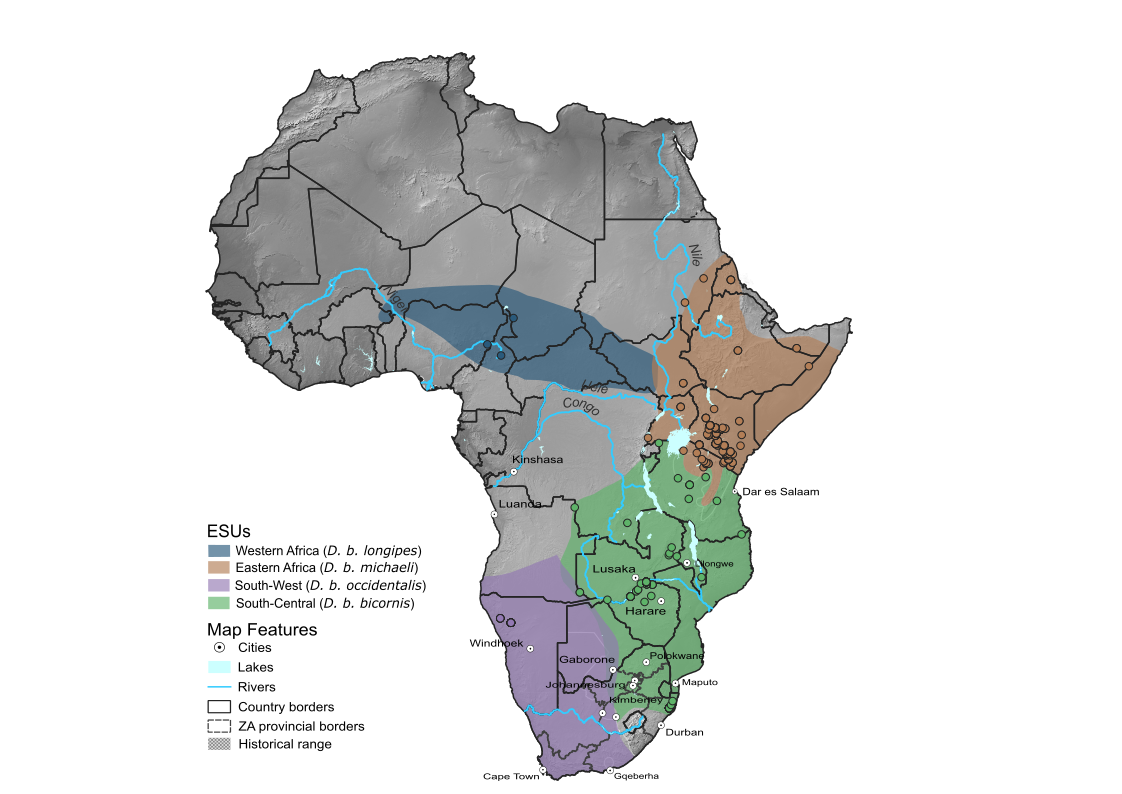
Figure 1:
Natural distribution of black rhinoceros in Africa. Base colours show the current and historical distribution of the species across Africa. Historical range based on the IUCN distribution for the species is shown as hashed white regions. Current distribution and its management units are indicated by coloured regions. Western ESU is extinct. Points represent a locality which has been sampled for genetic data and correspond through colour to the ESU they are within. ESU ranges are based on genetic data of populations. Distribution data sources: ESU ranges estimated by Balfour et al. (2026). Historical range – Emslie, R. 2020. Diceros bicornis. The IUCN Red List of Threatened Species 2020, e.T6557A152728945. https://dx.doi.org/10.2305/IUCN.UK.2020-1.RLTS.T6557A152728945.en (Accessed 24th July 2026).

There are currently four proposed black rhino subspecies, one of which is considered extinct.
There are three extant subspecies among contemporary populations (Balfour et al. 2025).
The guidelines provided in this document are based on genetic data translated into the Evolutionarily Significant Units (ESUs) and Genetic Management Units (GMUs) listed below:
No GMUs are recognised at present.
* Extinct in these countries.
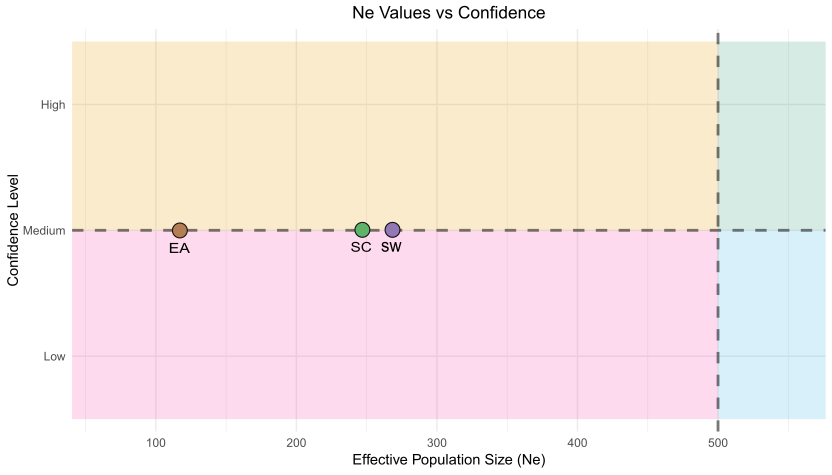
Table 1. Effective population size, Ne500 indicator, and confidence in the values calculated per ESU for black rhinoceros. Colour of the ESU label is linked to the colour used in Figure 1. Colour of Ne500 and confidence text corresponds to positive (green) or negative interpretation (orange/red). Overall Ne500 indicates the proportion of the total ESUs that have an Ne over 500. proportion of the total ESUs that have an Ne over 500.
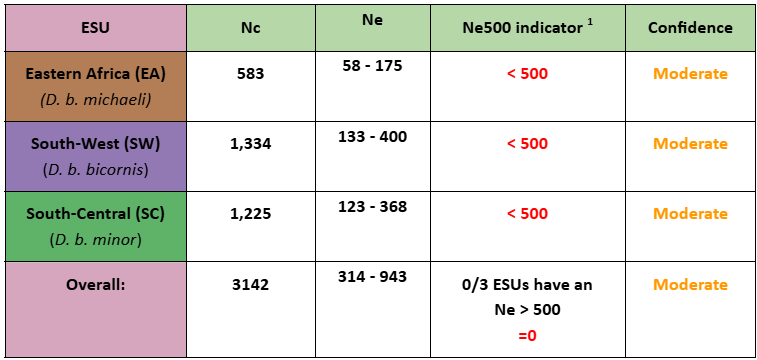
All three genetic management units have an Ne below 500 based on population census data. ESUs with Ne < 500 are highly susceptible to rapid loss of genetic diversity and are at high risk of extinction due to genetic threats. Although effective population size based on genetics was estimated in Moodley et al. 2017, here we calculated Ne using census data due to ambiguous population assignments; both methods result in an Ne500 value of 0.
Confidence is moderate as the evaluation is based on scientific papers (Mellya et al. 2025; Moodley et al. 2017; Moodley and Robovsky 2025; Sánchez-Barreiro et al. 2023) and IUCN or regional assessment data from within the last decade (Emslie 2020; Ferreira et al. 2025). However, population numbers per ESU to calculate Ne500 were inconsistent and may not have captured the true presence of this species across the continent.
1 Proportion of populations within species with an effective population size (Ne) greater than 500
(https://www.gbf-indicators.org/metadata/headline/A-4)
2 Proportion of populations maintained within species
(https://ccgenetics.github.io/guidelines-genetic-diversity-indicators/docs/2_Theoretical_background/PM-indicator.html)

We are grateful to Drs Peter Goodman, Richard Emslie and Prof Oliver Ryder for their valuable comments and for taking the necessary time and effort to critically review the initial guidelines.
If you have any additional questions related to these guidelines, please contact ConGen Africa at info@congenafrica.com.