ConGen Africa

GENETIC MANAGEMENT GUIDELINES

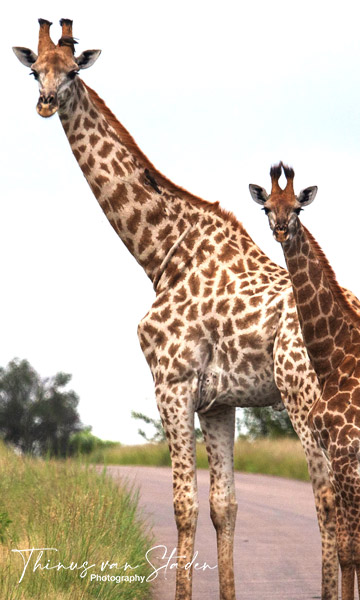
Southern Giraffe Giraffa giraffa

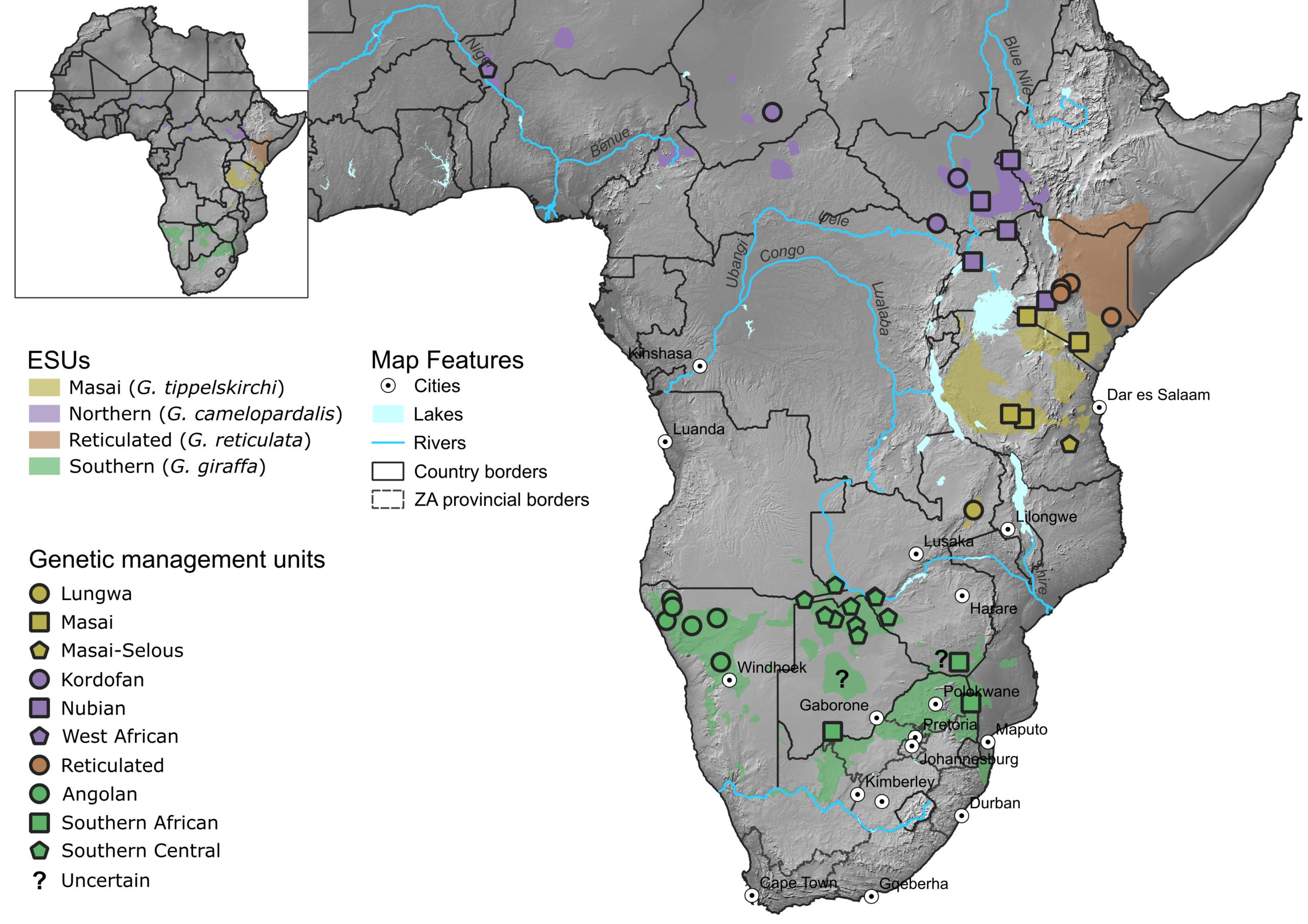
Recent genetic studies (Bertola et al. 2024; Coimbra et al. 2021; Fennessy et al. 2016; Winter et al. 2018) showed that there are four separate giraffe lineages with different demographic histories. These lineages correspond to four recognised species of giraffe (see Appendix, Figure A1 for their distribution): Giraffa camelopardalis (northern), G. reticulata (reticulated), G. tippelskirchi (Masai), G. giraffa (southern). Within the southern giraffe, two subspecies are recognised: G. g. giraffe (South African subspecies) and G. g. angolensis (Angolan giraffe). For permitting purposes, South Africa recognises G. c. giraffa (updated taxonomy G. g. giraffa; Coimbra et al. 2021), and within Namibia, both G. c. angolensis (updated taxonomy G. g. angolensis; Coimbra et al. 2021) and G. c. giraffa (updated taxonomy G. g. giraffa; Coimbra et al. 2021) are used. A recent evaluation of the taxonomic status of giraffe (Giraffa spp.) by the IUCN SSC Giraffe and Okapi Specialist Group now recognises four distinct giraffe species and seven subspecies (IUCN SSC Giraffe and Okapi Specialist Group Taxonomic Task Force 2025).
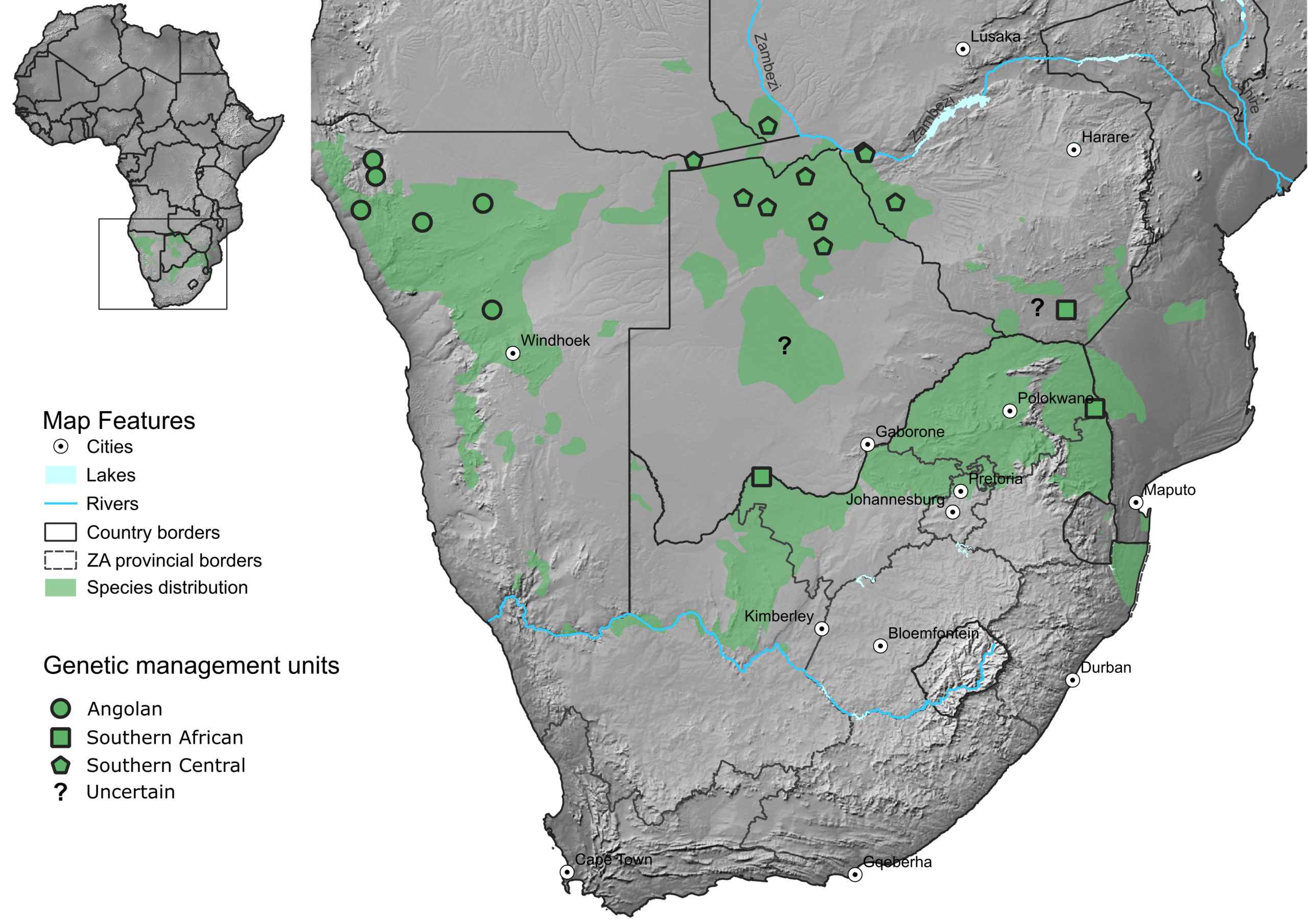

Natural distribution of southern giraffe (Giraffa giraffa) in green shading. Genetic Management Units (GMUs) are indicated by different symbols. Each point represents a locality which has been sampled for genetic data and thus the GMU (symbol) designation of each locality is based on genetic data. The question marks indicate populations of uncertain GMU assignment. In the case of Bubye Valley Conservancy (southern Zimbabwe), most of the population harbours an Angolan mitochondrial lineage (G. g. angolensis), but cluster with the South African subspecies on the nuclear level (G. g. giraffa) (Winter et al. 2018; Prochotta et al. 2024). In the case of the Central Kalahari Game Reserve (central Botswana), the population harbours an Angolan mitochondrial lineage (G. g. angolensis) and on the nuclear genome clusters with the South African subspecies (G. g. giraffa), but with around 30% contribution from the Angolan subspecies (Winter et al. 2018; Prochotta et al. 2024). We were unable to assign these populations to a GMU in these guidelines based on the nuclear data, as they were not included in Bertola et al. (2024). A new analysis including published data from all populations should allow for these two populations to be assigned to a GMU. The inset indicates the part of Africa shown in the main map. Distribution data sources: South Africa and eSwatini – Birss, C., Rushworth, I., Collins, N. B., Peinke, D. & Buijs, D. 2017. Inferred natural distribution ranges of certain large mammals in South Africa. Unpublished GIS coverage. Rest of Africa – IUCN (International Union for Conservation of Nature) 2018. Giraffa camelopardalis. The IUCN Red List of Threatened Species. Version 2021-1. https://www.iucnredlist.org. Downloaded on 23/04/2021.

Management Level

Subspecies

Two subspecies of southern giraffe are recognised based on genetic data (Coimbra et al. 2021, Bertola et al. 2024) and the traffic light system employed by the IUCN SSC Giraffe and Okapi Specialist Group Taxonomic Task Force which includes morphological, genetic and biogeographical evidence (IUCN SSC Giraffe and Okapi Specialist Group Taxonomic Task Force 2025) .

  • Giraffa giraffa angolensis (Angolan)
  • Giraffa giraffa giraffa (South African)


However, the guidelines provided in this document are based on genetic data translated into the Evolutionarily Significant Units (ESUs) and Genetic Management Units (GMUs) listed below.

Evolutionarily Significant Units (ESUs)

No ESUs are recognised at present.

Genetic Management Units (GMUs)
  • Angolan (AO)
  • Southern African (SA)
  • Southern Central (SC)

Management Boundaries

See Figure 1 for visual representation. Text descriptions follow.
Genetic Management Units (GMUs)
  • Angolan (AO): central Botswana, Namibia.
  • Southern African (SA): South Africa, southern Botswana, western Mozambique, southern Zimbabwe, eSwatini.
  • Southern Central (SC): southern Zambia, northern Botswana, northern Zimbabwe.

Genetic Risk

  • Global population Nc: 48,186 (Marneweck et al. 2025).
  • South African population Nc: 20,821 (Marneweck et al. 2025; Hoffman et al. 2025).
  • Genetic indicators are calculated at GMU level. This is based on a best case scenario where gene flow is maintained within GMUs.
  • If values are reported as a range, the average is used for subsequent calculations.
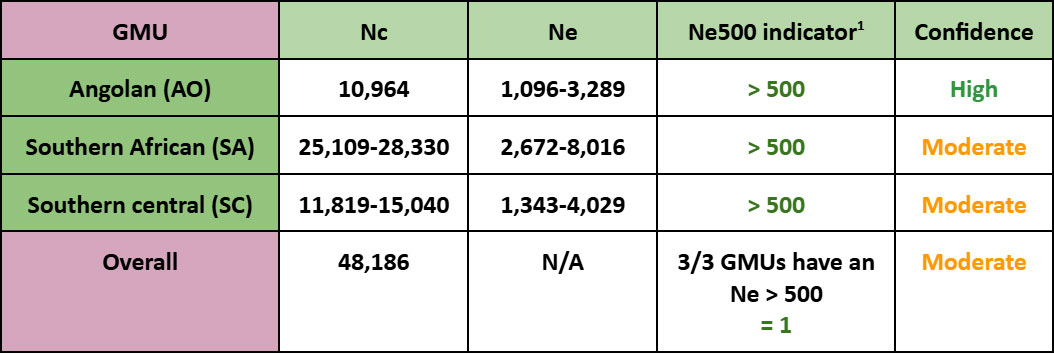
Table 1. Effective population size, Ne500 indicator, and confidence in the values calculated per GMU for southern giraffes. The colour of the GMU label is linked to the colour used in Figure 1. Colour of Ne500 and confidence text corresponds to positive (green) or negative interpretation (orange/red). Overall Ne500 indicates the proportion of the total GMUs that have an Ne over 500.
Genetic Management Units (GMUs)
  • Genetic indicators
    • Ne500 indicator1:
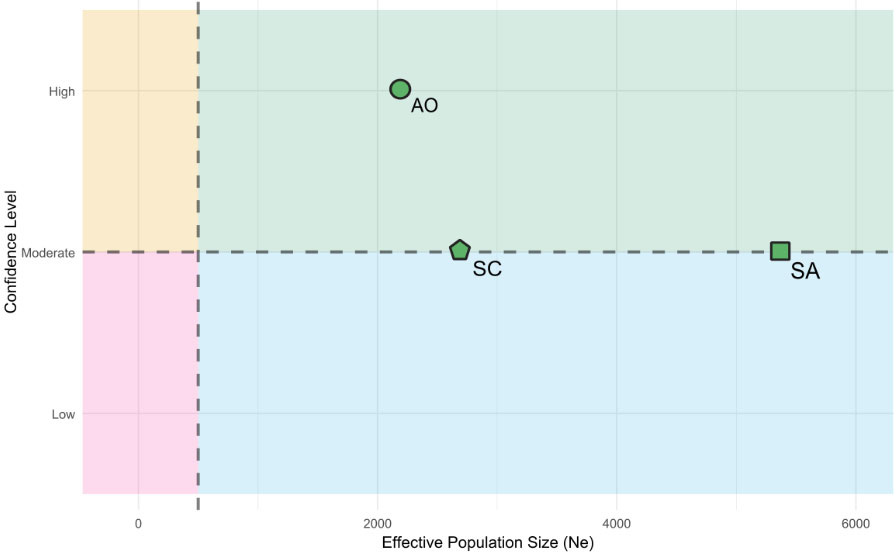
      • Angolan (AO) individuals: 15,663 (Marneweck et al. 2025). With assumed maturity percentage of 70 % (Muller et al. 2018), Nc: 10,964. Using an Nc:Ne ratio of 0.1-0.3, Ne = 1,096-3,289.
      • Southern Africa (SA) individuals: 35,870-40,471 (Marneweck et al. 2025; Hoffman et al. 2025). With assumed maturity percentage of 70 % (Muller et al. 2018), Nc: 25,109-28,330. Using an Nc:Ne ratio of 0.1-0.3, Ne = 2,672-8,016.
      • Southern central (SC) individuals: 16,884-21,486 (Marneweck et al. 2025).  With assumed maturity percentage of 70 % (Muller et al. 2018), Nc: 11,819-15,040. Using an Nc:Ne ratio of 0.1-0.3, Ne = 1,343-4,029.

All three genetic management units have an Ne above 500 which indicates each GMU will maintain genetic diversity, assuming gene flow is maintained within GMUs, thus indicating lower genetic risk.

  • Proportion of populations maintained (PM2)
  • The global populations of southern giraffes comprise three GMUs, therefore the proportion of populations maintained globally: 3/3 = 1. 
  • Diversity loss
    • Functional variation
        • There is risk of functional variation loss in G. g. angolensis due to having smaller, historically bottlenecked populations (e.g., desert-dwelling Angolan giraffe in northwest Namibia) which are particularly susceptible to loss of adaptive genetic variants (Prochotta et al. 2024). 
    • Divergent lineages
        • There is low risk of losing divergent lineages as both of the subspecies, covering all three GMUs, have shown population increase in recent decades. 
  • Hybridisation/introgression
      • There is evidence of introgression between Angolan and South African giraffes at certain contact zones, with admixture analyses showing intermediate ancestry in populations such as those in the Central Kalahari Game Reserve (CKGR). This hybridisation is not widespread across all populations (Prochotta et al. 2024). 
  • Lower turnover/constraints on adaptive opportunities
      • There has been reduction of genetic diversity genome wide and runs of heterozygosity in G. g. angolensis, especially within smaller, isolated groups, indicating inbreeding (Prochotta et al. 2024). These low levels of heterozygosity and high levels of inbreeding are seen across southern giraffes, likely due to a historical bottleneck, and may still constrain adaptive opportunities despite population growth, especially alongside pressures such as changing climate. 
  • In situ genetic threat level 
    • In situ Risk (Moderate) 

Southern giraffes exist in fragmented populations, and have evidence of inbreeding and low heterozygosity within populations. However genetic management units have an Ne well above 500 and are relatively stable so with facilitation of gene flow between populations, risk is moderate (Hoffman et al. 2025; Marneweck et al. 2025). For more threats, see the IUCN Red List and South African Red List.

  • Confidence in in situ threat level
    • Confidence score (Moderate)

Confidence is moderate as the assessment is based on regional assessment data published within the last year (Marneweck et al. 2025; Hoffman et al. 2025). However, population numbers per GMU to calculate Ne500 were assumed from population data per country or subspecies provided in Marenweck et al. (2025) as well as the South African red list assessment (Hoffman et al. 2025). These assumptions of individuals per GMU may potentially misrepresent the exact current population census sizes.
  • Ex situ representation
    • The southern giraffe is more uncommon in traditional zoos than other giraffe species, with only 20 Angolan and 45 from the southern GMUs in zoos worldwide (Tutchings et al. 2013).
    • High levels of inbreeding were detected in the genetic analysis of captive southern giraffes, with low levels of heterozygosity and known cases of mating with relatives (Frasier et al. 2026).
Figure 2. Effective population size compared to confidence in the value. Colour and shape of points and labelling corresponds to the colour and title of the GMU in Figure 1 and Table 1. Dashed lines divide the x axis into above and below Ne500, and the y axis into low and high confidence. GMUs in the low confidence quadrant should be further surveyed to increase confidence in the evaluation. Those with high confidence below Ne500 should have increased genetic management.

1 Proportion of populations within species with an effective population size (Ne) greater than 500
(https://www.gbf-indicators.org/metadata/headline/A-4)

2 Proportion of populations maintained within species
(https://ccgenetics.github.io/guidelines-genetic-diversity-indicators/docs/2_Theoretical_background/PM-indicator.html)

Management Guidelines

  • Other species of giraffe should not be imported from the rest of Africa to southern Africa.
  • Manage the Southern African, Southern Central and Angolan GMUs as separate units to maintain genetic separation between the two subspecies.
  • The populations marked with question marks in Figure 1 (Bubye Valley Conservancy, Zimbabwe and the Central Kalahari Game Reserve, Botswana) should not be considered as sources for translocation purposes because of their genetic history with the Angolan subspecies (Prochotta et al. 2024).
  • In 1991 (Kruger 1994), animals from Namibia (Giraffa giraffa angolensis) were translocated to the Kgalagadi National Park in South Africa. Animals for this park must be genetically tested before translocation to avoid any further admixture between GMUs. 
  • Animals on private ranches should be tested genetically before translocations to prevent mixing of different GMUs.
  • All GMUs have Ne > 500 under the assumption of gene flow within GMUs. Therefore, management must strive to facilitate natural migration and gene flow between isolated populations within each GMU, while taking cognisance of the other guidelines above.

IUCN Status:

  • Global: Near threatened (indicated below).
  • South Africa: Least concern. 

Limitations & Assumptions:

  • Previous translocations have occurred, without taking genetic structure between the species (ESUs) or within the southern giraffe (GMUs) into account.
  • Private ranches are likely to have individuals from other ESUs or these ranches have descendants from ESUs outside of southern Africa.

Priority Research:

  • Generate genetic data from undersampled southern African populations of both G. g. giraffa and G. g. angolensis.
  • Identify important corridors or natural dispersal routes for populations at local and regional levels.
  • Undertake genetic analysis to determine the level of hybridisation within translocated populations/newly established populations.
  • A comprehensive analysis including published genome-wide data from all populations should be conducted to enable assignment of all populations to a GMU, as some populations cannot be assigned due to being analysed in different studies (see question marks in Fig. 1).

Cited references:

  • Fennessy, J. et al. (2016). Multi-locus analyses reveal four giraffe species instead of one. Current Biology 26(18), 2543-2549. doi.org/10.1016/j.cub.2016.07.036.
  • Fraser, M.F., Heller, R., Bertola, L.D., Hvilsom, C., Balboa, R.F., Liu, X. and Bruniche-Olsen, A. (2026). Unfolding admixed ancestry and genomic diversity in zoo giraffes. Conserv Genet 27, 21. https://doi.org/10.1007/s10592-025-01757-4 
  • Hoffman, R., Brown, M.B., Marneweck, C. and Fennessy, J. (2025). A conservation assessment of Giraffa giraffa. In Patel, T., Smith, C., Roxburgh, L., da Silva, J.M. and Raimondo, D., editors. The Red List of Mammals of South Africa, Eswatini and Lesotho. South African National Biodiversity Institute and Endangered Wildlife Trust, South Africa. 
  • IUCN SSC Giraffe and Okapi Specialist Group Taxonomic Task Force. (2025). An evaluation of the taxonomic status of giraffe (Giraffa spp.). IUCN SSC Giraffe and Okapi Specialist Group. Windhoek, Namibia.
  • Kruger, J.W. (1994). The feeding ecology and behaviour of re-introduced giraffe (Giraffa camelopardalis) in the Kalahari Gemsbok National Park. PhD Thesis. University of Pretoria.
  • Marneweck, C.J., Brown, M.B., Ekandjo, P., Fennessy, S., Hoffman, R., Kipchumba, A., Muneza, A., Otten, F. and Fennessy, J. (Eds). (2025). State of Giraffe 2025: An update from the Giraffe Africa Database (GAD). Giraffe Conservation Foundation, Windhoek, Namibia.
  • O’Connor, D. et al. (2019). Updated geographic range maps for giraffe, Giraffa spp., throughout sub-Saharan Africa, and implications of changing distributions for conservation. Mammal Review 49, 285-299. doi.org/10.1111/mam.12165.
  • Prochotta, D. et al. (2024). Population genomics of the southern giraffe. Molecular Phylogenetics and Evolution 201.108198. doi.org/10.1016/j.ympev.2024.108198.
  • Tutchings, A., Fennessy, S., Marais, A. and Fennessy, J. (2013). Africa’s giraffe, Giraffa camelopardalis: A conservation guide. The Giraffe Conservation Foundation (GCF). Black Eagle Media.
  • Winter, S. et al. (2018). Limited introgression supports division of giraffe into four species. Ecology and Evolution 8, 10156-10165. doi.org/10.1002/ece3.4490.

Additional References:

  • Deacon, F. & Tutchings, A. (2019). The South African giraffe Giraffa camelopardalis giraffa: a conservation success story. ORYX 53(1), 45-48. doi.org/10.1017/S0030605317001612.
  • O’Connor, D. et al. (2019). Updated geographic range maps for giraffe, Giraffa spp., throughout sub-Saharan Africa, and implications of changing distributions for conservation. Mammal Review 49, 285-299. doi.org/10.1111/mam.12165.

Appendix:

Figure A1: Natural distribution of giraffe (Giraffa spp.) species (=ESUs), indicated by different colours. Genetic Management Units (GMUs) are indicated by different symbols, with the colour corresponding to the ESU to which it belongs. Each point represents a locality which has been sampled for genetic data and thus the GMU (symbol) and ESU (colour) designation of each locality is based on genetic data. The question marks indicate populations of uncertain GMU assignment; see Fig. 1 legend for more information. The inset indicates the part of Africa shown in the main map. Distribution data sources: South Africa and eSwatini – Birss, C., Rushworth, I., Collins, N. B., Peinke, D. & Buijs, D. 2017. Inferred natural distribution ranges of certain large mammals in South Africa. Unpublished GIS coverage. Rest of Africa – IUCN (International Union for Conservation of Nature) 2018. Giraffa camelopardalis. The IUCN Red List of Threatened Species. Version 2021-1. https://www.iucnredlist.org. 

Consultation:

  • IUCN SSC Conservation Genetics Specialist Group
  • IUCN SSC Giraffe and Okapi Specialist Group

Acknowledgements:

We are grateful to Profs Dan Parker and Paul Grobler and Dr David Stanton for their valuable comments and for taking the necessary time and effort to  critically review the initial guidelines. 

Queries:

If you have any additional questions related to these guidelines, please contact ConGen Africa at info@congenafrica.com.

Explore other species