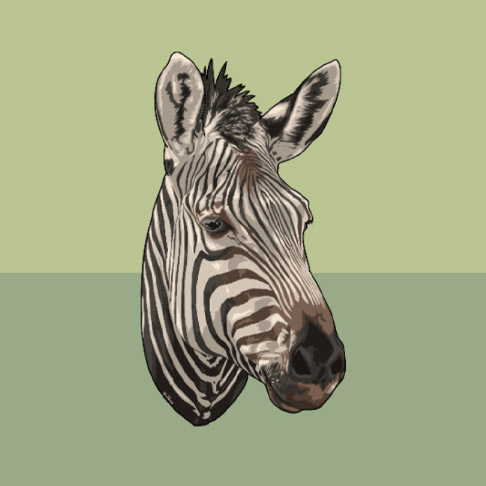
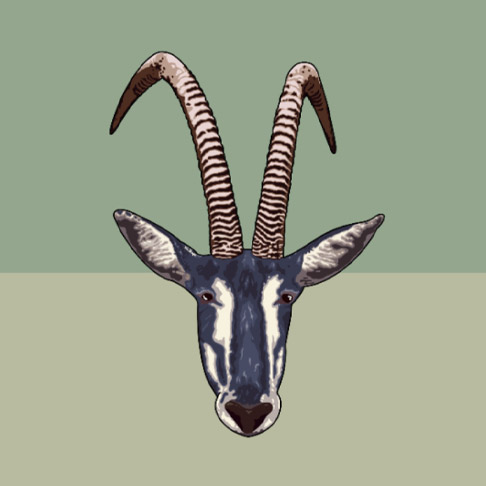
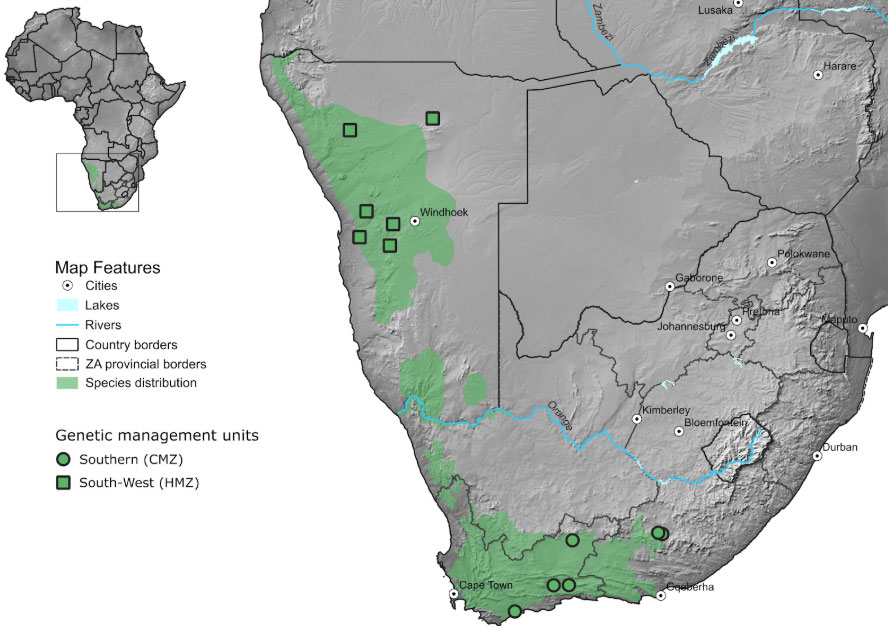
Within Equus zebra two subspecies are currently recognised (Equus zebra hartmannae: Hartmann’s mountain zebra, HMZ, and Equus zebra zebra: Cape mountain zebra, CMZ). They are primarily differentiated by their habitat and size, with CMZ being slightly smaller (Wilson & Reeder 2005). For permitting purposes in southern Africa, Namibia and South Africa currently utilise Equus zebra hartmannae and Equus zebra zebra, respectively. Early molecular investigations based on mitochondrial DNA were unable to detect any subspecific genetic structure, however, differentiation at the subspecific level was detected based on microsatellite data(Moodley & Harley 2005). These subspecies are therefore not considered Evolutionarily Significant Units (ESUs) but rather Genetic Management Units (GMUs). Figure 1 illustrates the geographic distribution of these GMUs. Within E. z. zebra, additional genetic structure has been identified corresponding to the individual reserves in which these animals are found (Mountain Zebra National Park, De Hoop Nature Reserve, Kammanassie Nature Reserve; e.g. Kotze et al. 2019), however, this differentiation is the result of recent anthropogenic (human-mediated) fragmentation and isolation before the 1950s from hunting and reduced habitat (converted to pasture for livestock; Millar, 1970).

Two subspecies of mountain zebra are recognised based on morphological characteristics (Wilson & Reeder 2005).
The guidelines provided in this document are based on genetic data translated into the Evolutionarily Significant Units (ESUs) and Genetic Management Units (GMUs) listed below. However, the name that is used for permits in southern Africa reflect the subspecies designations.
No ESUs are recognised at present.
There are two GMUs within the species corresponding to the two subspecies.
See Figure 1 for visual representation. Text descriptions follow.
Genetic Management Units (GMUs)
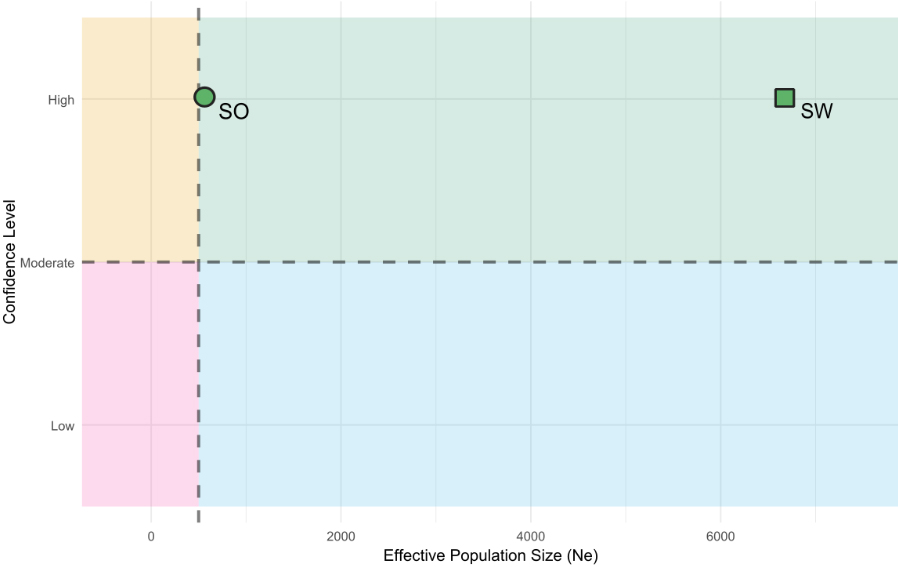
Table 1. Effective population size, Ne500 indicator, and confidence in the values calculated per ESU for mountain zebra. The colour of the GMU label is linked to the colour used in Figure 1. Colour of Ne500 and confidence text corresponds to positive (green) or negative interpretation (orange/red). Overall Ne500 indicates the proportion of the total GMUs that have an Ne over 500.
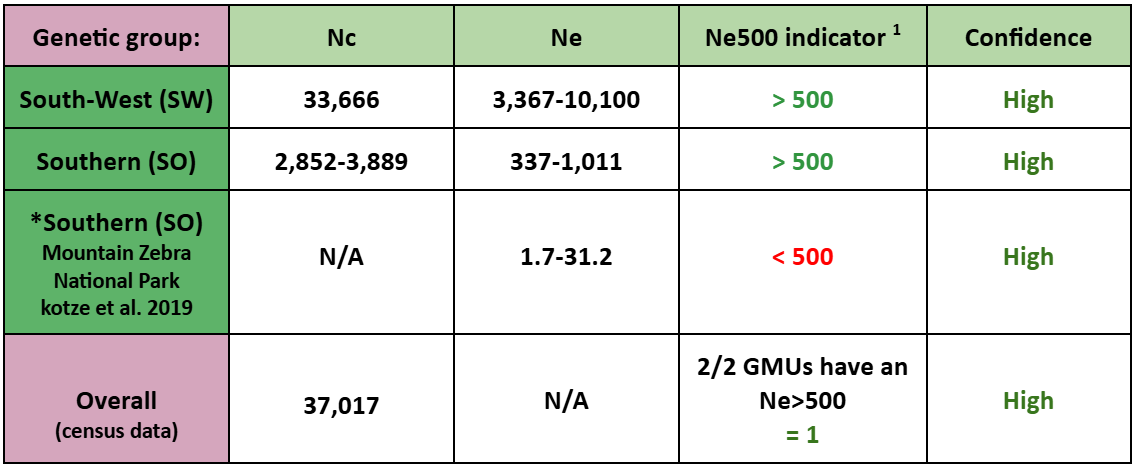
Both management units have an Ne above 500 which indicates each GMU will maintain genetic diversity, assuming gene flow is maintained within GMUs, thus indicating lower genetic risk. *Although Ne based on census size is above 500, genetic data indicate that Ne for the largest subpopulation (Mountain Zebra National Park) is well below 500.
Mountain zebras are at risk of continued diversity loss through fragmented habitats and isolated populations. Low heterozygosity within remaining populations may pose future issue to the health of the species. The Cape mountain zebra exists in smaller numbers than Hartmann’s mountain zebra and are therefore more likely to experience constraint on their adaptive opportunities. There is also significant risk of hybridisation, which could further affect diversity loss in the form of divergent lineage and functional variation loss. For other threats, see the IUCN Red List, South African Red List (CMZ), and South African Red List (HMZ) .
Confidence levels are supported by data on heterozygosity from recent genomic studies using microsatellite markers (Kotze et al. 2019) and IUCN or regional assessment data from within the last decade (de Villiers et al. 2025; Gosling et al. 2019; Hrabar et al. 2015; Patel et al. 2025).
1Proportion of populations within species with an effective population size (Ne) greater than 500
(https://www.gbf-indicators.org/metadata/headline/A-4)
2Proportion of populations maintained within species
(https://ccgenetics.github.io/guidelines-genetic-diversity-indicators/docs/2_Theoretical_background/PM-indicator.html)
South-West (SW)
Southern (SO)

We are grateful to Drs Rae Smith and Peter Novellie for their valuable comments and for taking the necessary time and effort to critically review the initial guidelines.
If you have any additional questions related to these guidelines, please contact ConGen Africa at info@congenafrica.com.