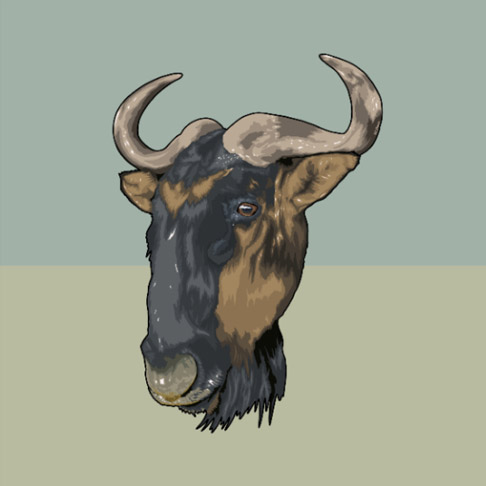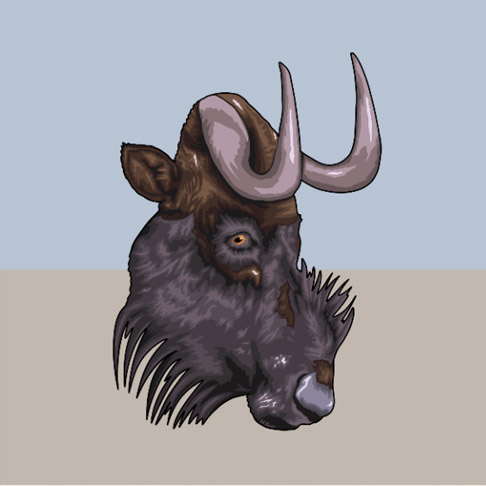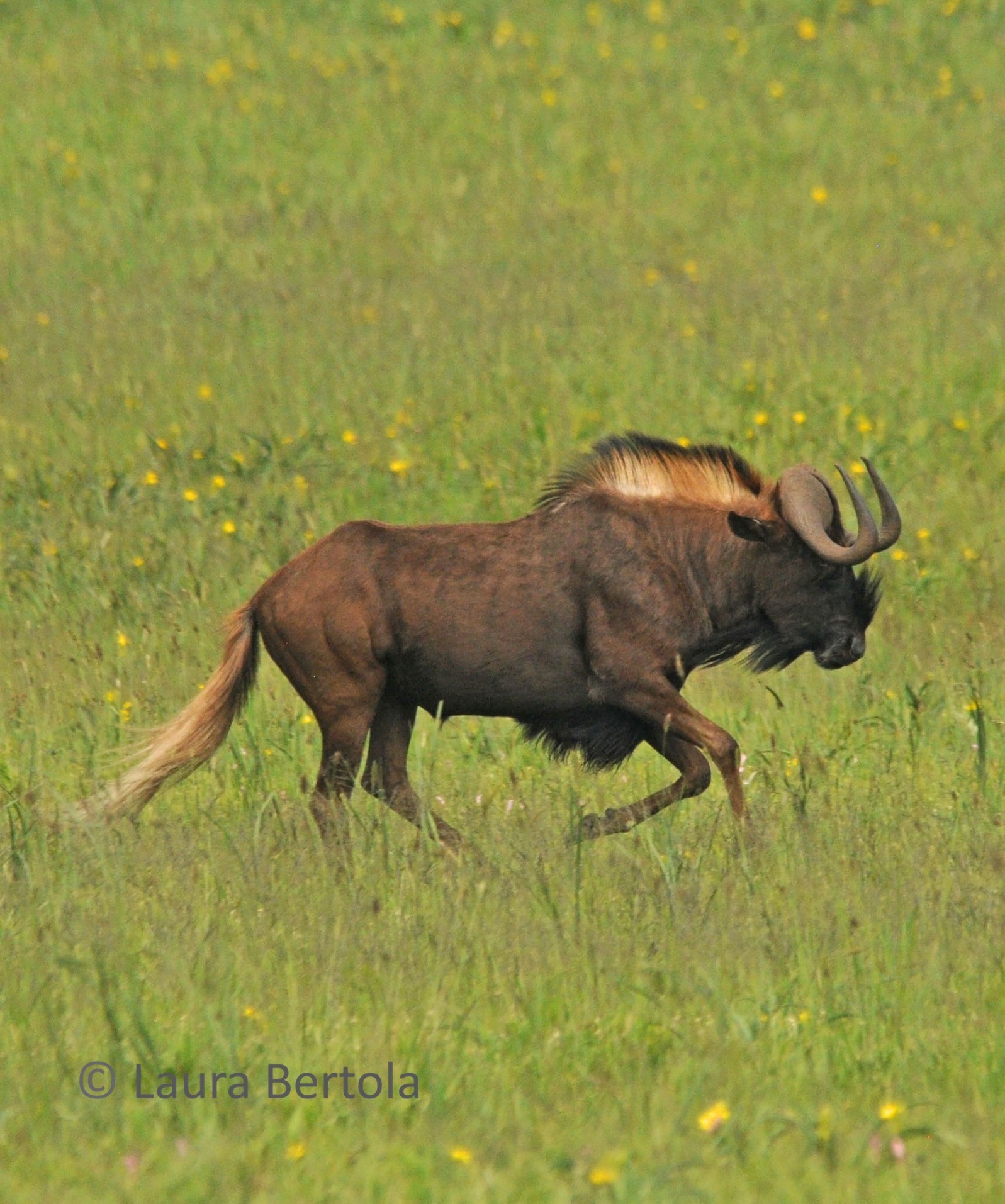
The black wildebeest Connochaetes gnou (Zimmermann, 1780) is endemic to South Africa and was driven to near extinction in the early 1900’s due to over-exploitation, disease outbreaks and habitat destruction (Von Richter, 1974). A severe drought in 1933 caused the population to go through a second bottleneck and by 1938 there were only an estimated 300 animals remaining (Kirkman, 1938). Numbers have subsequently recovered and according to the IUCN, the population is currently listed as least concern and total population size is estimated at 11,158 animals (IUCN, 2017). They have been widely reintroduced on nature reserves and private farms throughout their natural distribution range (including Eswatini and Lesotho). Black wildebeest have also been introduced outside their natural distribution range, with animals currently present on privately owned farms in Namibia and Botswana (Grobler et al., 2018; Liu et al., 2024). For permitting purposes in southern Africa, Namibia and South Africa currently utilise Connochaetes gnou. There is only one recognised species with no ESUs or GMUs. Figure 1 illustrates the geographic distribution of the species.


No subspecies are recognised at present.
No ESUs are recognised at present.
No GMUs are recognised at present.
The species formerly occurred in Lesotho, eSwatini and South Africa (the Northern Cape, Western Cape, Eastern Cape, throughout the Free State, northward into the North West province, Gauteng and Mpumalanga, extending into western KwaZulu-Natal).
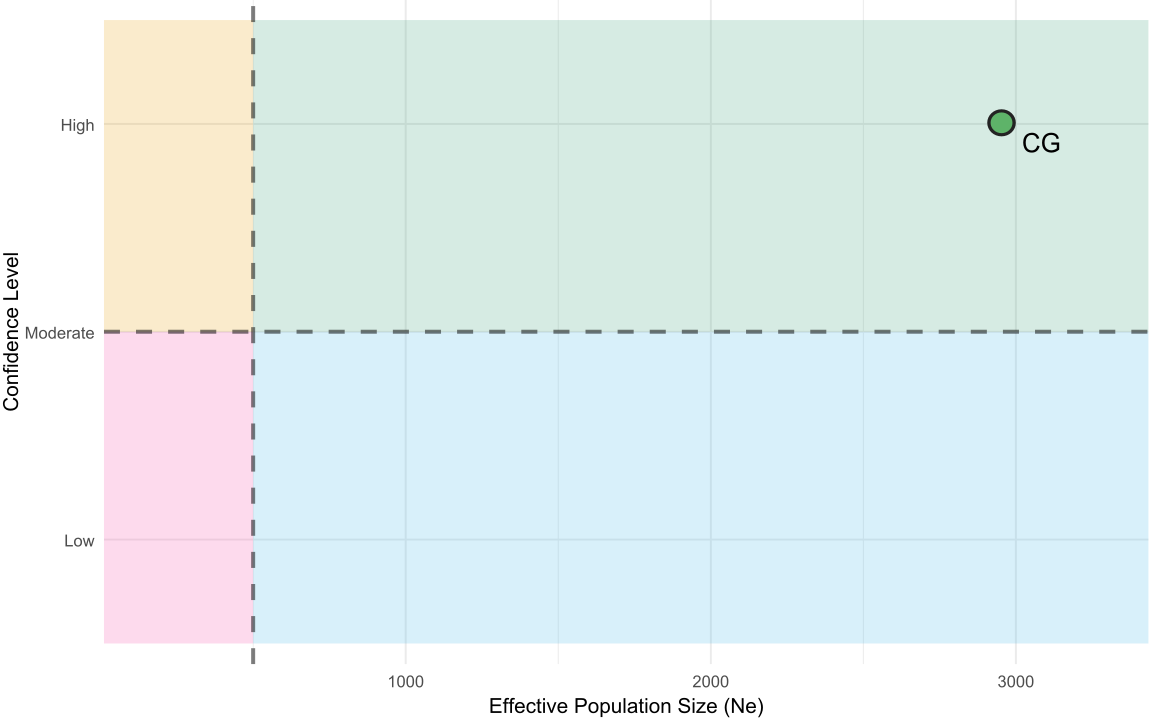
Table 1. Effective population size, Ne500 indicator, and confidence in the values calculated per ESU for black wildebeest. Colour of the ESU label is linked to the colour used in Figure 1. Colour of Ne500 and confidence text corresponds to positive (green) or negative interpretation (orange/red). Overall Ne500 indicates the proportion of the total ESUs that have an Ne over 500.
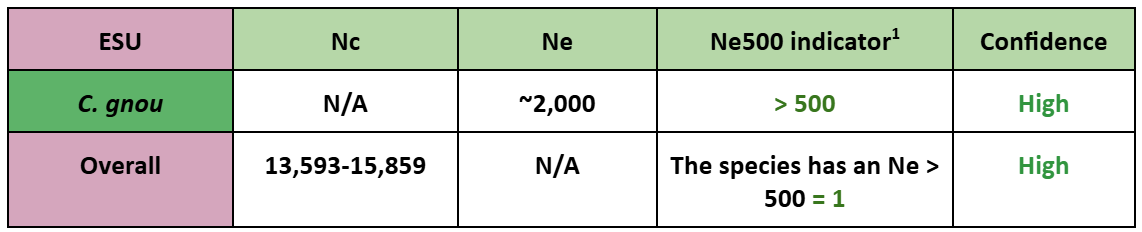
C. gnou has an Ne above 500 which indicates the species will maintain genetic diversity, assuming gene flow is maintained between populations, thus indicating lower genetic risk.
Black wildebeest are seen to be increasing in population number across their distribution and have an effective population size above 500 (Vrahimis et al. 2017). Hybridisation with blue wildebeest is the most significant threat to their genetic diversity. With facilitation of gene flow between populations and caution towards mixing any potential hybrids, risk is moderate. For more threats, see the IUCN Red List and South African Red List.
Confidence is high as the assessment is based on IUCN and regional assessment data from within the last decade (Vrahimis et al. 2018; Shrader and da Silva 2025) as well as scientific papers on the species genetics using microsatellites (Grobler et al. 2018).
1 Proportion of populations within species with an effective population size (Ne) greater than 500
(https://www.gbf-indicators.org/metadata/headline/A-4)
2 Proportion of populations maintained within species

We are grateful to Profs Paul Grobler and Rouvay Roodt-Wilding and Dr David Mallon for their valuable comments and for taking the necessary time and effort to critically review the initial guidelines.