ConGen Africa

GENETIC MANAGEMENT GUIDELINES

Leopard Panthera pardus

The leopard (Panthera pardus) is one of five extant cat species which also include lion (Panthera leo), snow leopard (Panthera uncia), jaguar (Panthera onca) and tiger (Panthera tigris). African leopard Panthera pardus pardus (Linnaeus 1758) is currently recognised as one of the eight subspecies of leopard. It is a  widespread subspecies with a mostly sub-Saharan African distribution. The subspecies is now locally extinct in Mauritania, Tunisia, Togo, Morocco, Algeria, Libya and most likely Gambia and Lesotho. For permitting purposes in southern Africa, Namibia and South Africa currently utilise Panthera pardus pardus. This assessment adopted morphological and genetic evidence, providing the basis for the recognition of eight Evolutionarily Significant Units (ESUs) which correspond to the eight subspecies of leopard. African leopards form part of one of these ESUs and there are currently no Genetic Management Units (GMUs) in southern Africa. Figure 1 illustrates the geographic distribution of three mitochondrial DNA lineages across the continent.


Figure 1: Natural and current distribution of the African leopard (Panthera pardus pardus) in southern Africa, illustrated by the hashed white lines and the green shading, respectively. Each point represents a locality which has been sampled for genetic data, with mitochondrial lineages within the subspecies indicated by different shades of green of the points. This is to illustrate that there is some genetic variation within the subspecies, but that all the lineages still belong to the same subspecies. Points for locations where both the Central and Southern lineages are found have been separated such that both colours are visible (i.e. in southern Mozambique and the lowveld region of South Africa). Note: The point in Algeria has an unknown location (Paijmans et al. 2018) and was thus placed in the historical range within the country. The range of other subspecies that occur outside Africa are not shown. Distribution data source: Peter Gerngross 2019. Panthera pardus. The IUCN Red List of Threatened Species. Version 2021-1.   https://www.iucnredlist.org

Management Level

Subspecies
Eight subspecies of leopard are recognised based on morphological characteristics (Kitchener et al. 2017) and genetic data (Uphyrkina et al. 2001).
  • Panthera pardus orientalis (Amur leopard)
  • Panthera pardus tulliana (Anatolian leopard)
  • Panthera pardus delacouri (Indochinese leopard)
  • Panthera pardus nimr (Arabian leopard)
  • Panthera pardus pardus (African leopard)
  • Panthera pardus fusca (Indian leopard)
  • Panthera pardus kotiya (Sri Lankan leopard)
  • Panthera pardus melas (Javan leopard)

The guidelines provided in this document are based on genetic data, which confirms that the subspecies are equivalent to Evolutionarily Significant Units (ESUs).
Evolutionarily Significant Units (ESUs)

See under subspecies heading above.

Genetic Management Units (GMUs)

No GMUs are recognised at present.

Management Boundaries

See Figure 1 for visual representation of African management boundaries (Arabian and Asiatic distribution excluded) and figure legend for more detail.

Subspecies
  • Panthera pardus pardus: Africa south of the Sahara and northern Africa.


Genetic risk

  • Global Nc: 78,780 (Slovikosky et al. 2025; Swanepoel et al. 2016).
  • South African Nc: 1,688–6,979 (Mann et al. 2025).
  • To keep the scope of guidelines consistent, the Ne500 indicator will focus on the African leopard only.
  • Genetic indicators are calculated at ESU level which correlates to subspecies for leopards. These calculations are based on a best case scenario where gene flow is maintained.
  • If values are reported as a range, the average is used for subsequent calculations.

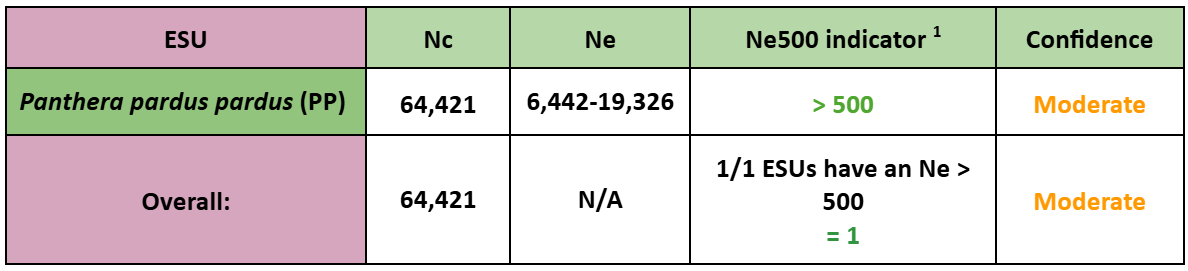
Table 1. Effective population size, Ne500 indicator, and confidence in the values calculated for African leopards. Colour of the ESU label is linked to the colour used in Figure 2. Colour of Ne500 and confidence text corresponds to positive (green) or negative  interpretation (orange/red). Overall Ne500 indicates the proportion of the total ESUs that have an Ne over 500.
Genetic Indicators
  • Ne500 indicator1
    • Pardus pardus pardus individuals:  107,369 (Slovikosky et al. 2025). With assumed maturity percentage of 60% (Swanepoel et al. 2016), Nc: 64,421. Using an Nc:Ne ratio of 0.1-0.3, Ne = 6,442-19,326.

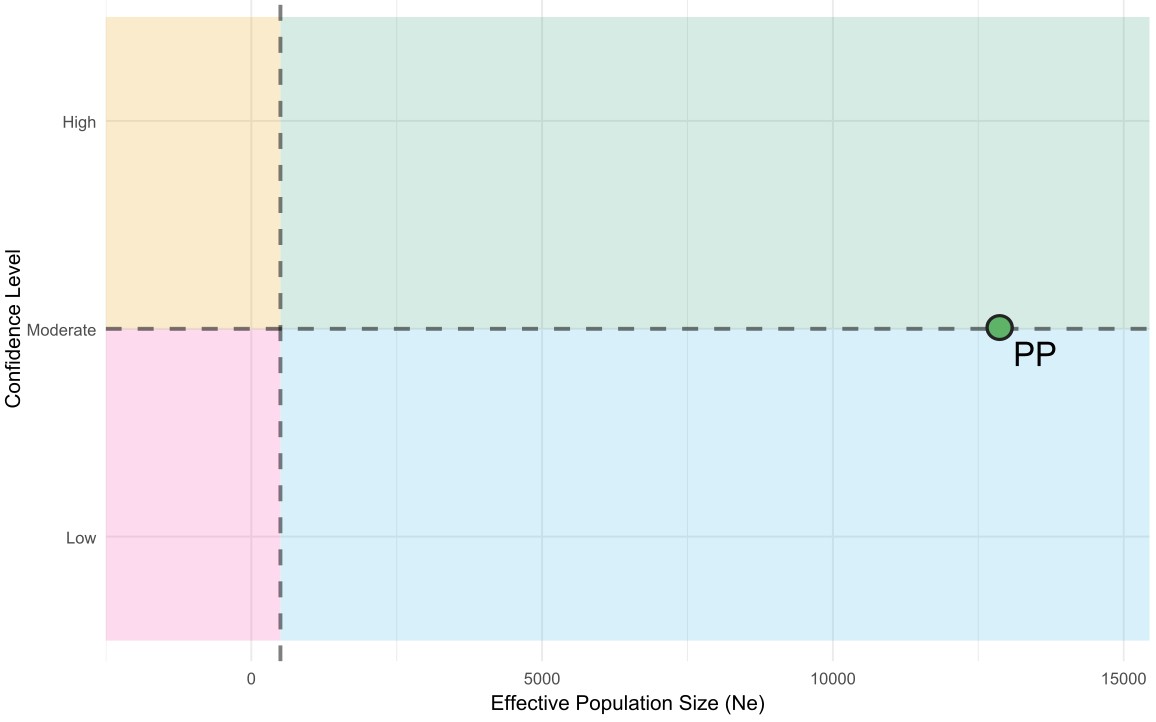
The African ESU has an Ne above 500 which indicates the ESU will maintain genetic diversity, assuming gene flow is maintained, thus indicating lower genetic risk. For comparison, the Ne of other leopard subspecies ranges from 12-1,542 (Calculated using Nc data from IUCN subspecies Red Lists).

  • Proportion of populations maintained (PM2):
    • The global populations of leopards make up 8 subspecies, considered ESUs. Therefore the proportion of populations maintained globally: 8/8 = 1.
Diversity Loss
  • Functional variation: There is risk of functional variation loss due to massive reduction in distribution, with leopards now only occupying 25-37% of their historical range causing fragmented/isolated populations (Jacobson et al. 2016). Due to this, there has likely been a loss of traits that were adapted to habitats the species formerly occupied.
  • Divergent lineages: There is risk of losing divergent lineages due to small remaining population sizes in several areas of its range as well as Human-leopard conflict, as a result of real or perceived predation on livestock.
Hybridisation/introgression
  • There is no evidence of persistent hybridisation between leopard subspecies and no detectable introgression. There is also no evidence of hybridisation with other Panthera species in the wild.
Lower turnover/constraints on adaptive opportunities
  • African leopards have the highest genetic diversity of big cats, therefore less constraints on adaptive potential than other subspecies of leopards (Pečnerová et al. 2021).
In situ genetic threat level
  • In situ risk (Low)
    Leopards exist in small populations, however no current genetic threats exist for P. p. pardus as genetic diversity is high and there is no evidence of inbreeding in southern African populations studied thus far. For more threats, see the IUCN Red List and South African Red List.
 
  • Confidence in in situ threat level
    • Confidence score (Moderate)
      Confidence is moderate as the evaluation is based on scientific papers (Slovikosky et al. 2025; Pečnerová et al. 2021) and IUCN or regional assessment data from within the last decade (Stein 2025; Swanepoel et al. 2016; Mann et al. 2025). However, population numbers for the African ESU to calculate Ne500 were taken from estimates provided in Slovikosky et al. (2025), meaning they may be inaccurate.
Ex situ representation
  • Leopard subspecies exist in captive populations within southern Africa, North and Central America, Europe, and Asia totalling to 741 individuals in 230 institutions across 58 countries.

Figure 2. Effective population size compared to confidence in the value. Colour of points and labelling corresponds to the colour and text for the ESU in Table 1. Dashed lines divide the x axis into above and below Ne500, and the y axis into low and high confidence. ESUs in the low confidence quadrant should be further surveyed to increase confidence in the evaluation. Those with high confidence below Ne500 should have increased genetic management.
1 Proportion of populations within species with an effective population size (Ne) greater than 500
(https://www.gbf-indicators.org/metadata/headline/A-4)

2 Proportion of populations maintained within species
(https://ccgenetics.github.io/guidelines-genetic-diversity-indicators/docs/2_Theoretical_background/PM-indicator.html)

Genetic Management Guidelines

  • No import of other subspecies to Africa.
  • While management objectives may vary, translocation guidelines should be grounded in ecological and genetic principles to minimize risks such as disrupting population genetic structures or reducing genetic integrity. In cases where translocations serve critical conservation goals—such as restoring populations, increasing genetic diversity, or mitigating human-wildlife conflict—guidelines should be applied with careful consideration of both risks and benefits.
  • Translocation of individuals should be avoided (if possible), unless it serves to recolonise or reinstate previously disrupted gene flow. 
  • If it is not possible to avoid translocation, then regional variations in the spatial requirements of leopards should be considered. This will inform the translocation distance that is suitable for the specific area/habitat. 
  • The driving force of genetic differentiation within the African leopard appears to be isolation-by-distance (IBD; Pečnerová et al. 2021), therefore, management of leopard populations in southern Africa (and Africa as a whole) should aim to allow (and promote) natural dispersal as much as possible.
  • Ropiquet et al. (2015) recommended translocation distances of no more than 82 km, but this may be overly restrictive.
  • Individuals should be moved at least 200 km from the capture site to prevent capture site fidelity and homing instinct (Weise et al. 2015; Briers-Louw et al. 2019).
  • Translocation distances of greater than four diameters of the regionally known localised leopard home range should be considered, and this may vary greatly in various locations within the species distribution (Devens et al. 2018; Müller et al. 2022; McManus et al. 2022).
  • Therefore, translocation distances between 200-400 km should be considered to preserve the natural processes that led to the IBD pattern (McManus et al. 2022).
  • Translocations should occur within the same bioregion where possible to avoid the risk of outbreeding depression.
  • Natural gene flow within these bioregions should be encouraged to maintain genetic diversity and ensure continued population growth, keeping Ne > 500.
  • Two mitochondrial DNA lineages have been identified in the lowveld region of north-eastern South Africa, which appears to be a contact zone between Southern and Central mitochondrial DNA lineages (Morris et al. 2024; Tensen et al. 2024); therefore translocations from or into in this area should be carefully considered, and translocations from the lowveld to the highveld avoided, at least until the boundary between these lineages has been established’.
  • A tissue sample should be collected from all translocated individuals for further genetic analysis. These samples should be stored in the national SANParks or SANBI biobanks.

IUCN status

  • Global: Vulnerable (indicated below).
  • South Africa: Vulnerable.

Limitations & Assumptions

Limitations and assumptions:

  • Previous translocations likely did not take into account the isolation-by-distance (IBD) genetic pattern of leopards. 

Priority Research

  • Identify natural dispersal corridors at fine scale (local and regional levels), in order to protect, or (re)establish, such corridors, which will in turn preserve the natural processes that create the IBD spatial genetic structure observed in the species.
  • Determine the effective gene dispersal distance for additional populations throughout Africa, to guide maximum translocation distance, if translocations must take place.
  • For southern Africa, genetic data are required from populations in Angola, Botswana, Zimbabwe and southern Mozambique, as these areas are almost completely absent from genetic studies of the species thus far.
  • Understand the distribution of the contact zone between the two mitochondrial lineages identified in the lowveld region.
  • Full genome analysis of the southern African population to understand genomic diversity.
  • Long-term spatial and genetic monitoring of translocated leopards to evaluate homing tendencies, survival rates, and integration into new populations.
  • Determine how land-use affects gene flow and dispersal across fragmented landscapes. 

Cited references

  • Briers-Louw, W. D. et al. (2019). Big cats return to Majete Wildlife Reserve, Malawi: evaluating reintroduction success. African Journal of Wildlife Research 49(1), 34–50. doi.org/10.3957/056.049.0034.
  • Devens, C. et al. (2018). Counting the spots: The use of a spatially explicit capture–recapture technique and GPS data to estimate leopard (Panthera pardus) density in the Eastern and Western Cape, South Africa. African Journal of Ecology  56(4), 850–859. doi.org/10.1111/aje.12512.
  • Kitchener A.C. et al. (2017). A revised taxonomy of the Felidae. The final report of the Cat Classification Task Force of the IUCN/SSC Cat Specialist Group. Cat News Special Issue 11, 80 pp. https://repository.si.edu/handle/10088/32616. Accessed on 09 March 2025.
  • Mann, G.K.H., Williams, K.S. and da Silva, J.M. 2025. A conservation assessment of Panthera pardus. In Patel T, Smith C, Roxburgh L, da Silva JM & Raimondo D, editors. The Red List of Mammals of South Africa, Eswatini and Lesotho. South African National Biodiversity Institute and Endangered Wildlife Trust, South Africa.
  • McManus, J. et al. (2022). Assessment of leopard translocations in South Africa. Frontiers in Conservation Science  3, 943078. doi.org/10.3389/fcosc.2022.943078.
  • Morris, D.R. et al. (2024). Unravelling the maternal evolutionary history of the African leopard (Panthera pardus pardus). PeerJ  12:e17018. doi.org/10.7717/peerj.17018.
  • Müller, L. et al. (2022). Population size, density, and ranging behaviour in a key leopard population in the Western Cape, South Africa. PloS One 17(5), p.e0254507. doi.org/10.1371/journal.pone.0254507.
  • Pečnerová, P. et al. (2021). High genetic diversity and low differentiation reflect the ecological versatility of the African leopard. Current Biology 31, 1862-1871.e5. doi.org/10.1016/j.cub.2021.01.064.
  • Ropiquet, A. et al. (2015). Implications of spatial genetic patterns for conserving African leopards. Comptes Rendus Biologies 338, 728-737. doi.org/10.1016/j.crvi.2015.06.019.
  • Slovikosky, S.A., Petracca, L.S., Hunter, L.T.B. et al. Spatially explicit estimates of global population potential for leopard (Panthera pardus). Biodivers Conserv 34, 3785–3803 (2025). https://doi.org/10.1007/s10531-025-03131-9 
  • Stein, A.B. et al. 2025. Panthera pardus (amended version of 2025 assessment). The IUCN Red List of Threatened Species 2025: e.T15954A286153337. doi.org/10.2305/IUCN.UK.2025-2.  [Accessed on 27 January 2026].
  • Stein, A.B., Gerngross, P., Bauer, H., Chataigner, B., Drouilly, M., Henschel, P., Mann, G. and Searle, C. 2025. Panthera pardus ssp. pardus. The IUCN Red List of Threatened Species 2025: e.T271005149A271005197.doi.org/10.2305/IUCN.UK.2025-1.  [Accessed on 26 January 2026].
  • Tensen, L. et al. (2024). Mitogenomic characterisation of South African leopards and the effect of past climatic events. Journal of Zoological Systematics and Evolutionary Research 2024, 2174469. doi.org/10.1155/2024/2174469.
  • Uphyrkina, O. et al. (2001). Phylogenetics, genome diversity and origin of modern leopard, Panthera pardus. Molecular Ecology 10, 2617-2633. doi.org/10.1046/j.0962-1083.2001.01350.x.
  • Weise, F. J. et al. (2015). A home away from home: insights from successful leopard (Panthera pardus) translocations. Biodiversity Conservation  24(7), 1755–1774. doi.org/10.1007/s10531-015-0895-7.

Additional References

  • Anco, C. et al. (2018). Historical mitochondrial diversity in African leopards (Panthera pardus) revealed by archival museum specimens. Mitochondrial DNA Part A 29, 455-473. doi.org/10.1080/24701394.2017.1307973.
  • Mamugy, F. et al. (2024). SNP panel for non-invasive genotyping of leopard (Panthera pardus). bioRxiv 11.01.621452. doi.org/10.1101/2024.11.01.621452
  • Swanepoel, L.H. et al. 2016. A conservation assessment of Panthera pardus. In Child MF, Roxburgh L, Do Linh San E, Raimondo D, Davies-Mostert HT, editors. The Red List of Mammals of South Africa, Swaziland and Lesotho. South African National Biodiversity Institute and Endangered Wildlife Trust, South Africa.

Consultation

  • IUCN SSC Conservation Genetics Specialist Group
  • IUCN SSC Cat Specialist Group

Acknowledgements

We are grateful to Drs Bool Smuts, Jeannine McManus, Anne Ropiquet and Prof Michael Somers for their valuable comments and for taking the necessary time and effort to critically review the initial guidelines.

Queries

If you have any additional questions related to these guidelines, please contact ConGen Africa at info@congenafrica.com.

Explore other species